



 (NORWAY, 1/26/2026)
The quota advice for coldwater shrimp (Pandalus borealis) in the Barents Sea for 2026 recommends that total catches should not exceed 83,000 tonnes, according to new guidance from the Norwegian Institute of Marine Research (HI).
 This year’s recommendation represents a sharp reduction compared with quota advice in previous years, but only a moderate decrease compared with actual landings. As reported by Erlend Astad Lorentzen of HI, fishing activity has already been lower than advised levels in recent years.
“Since 2020, landings have been far below the quota recommendations. In 2024, however, landings peaked at around 95,000 tonnes,” says marine scientist Fabian Zimmermann.
Declining stock after high fishing pressure
The reduced quota advice for 2026 is primarily based on a decline in the shrimp stock following the high landings in 2024. According to HI, population estimates from the 2025 ecosystem expedition showed the lowest shrimp abundance recorded since the survey series began in 2004.
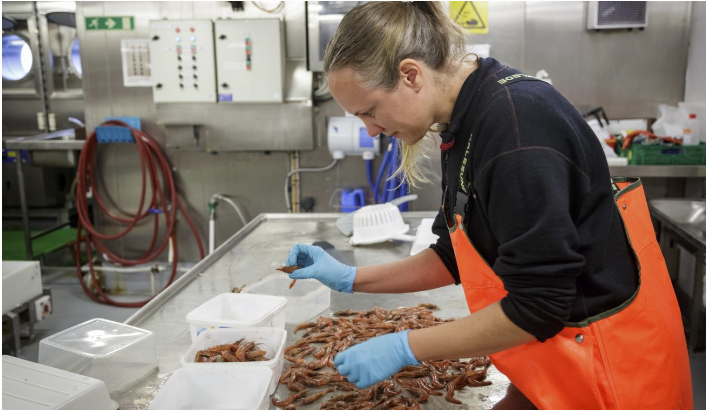
The Barents Sea ecosystem expedition is an important source of data on shrimp populations. Here technician Marita Larsen sorts shrimp in 2018. Photographer: Erlend Astad Lorentzen | Source: HI
In addition to the observed decline, high uncertainty in the population assessment has contributed to the more cautious recommendation.
Stock remains sustainable
Despite the lower estimate, researchers stress that the shrimp stock remains healthy.
“The population is still at a high and sustainable level, but it is now closer to what we can expect as normal in the long term,” explains Zimmermann.
.png)
Stock assessment summary of northern shrimp in ICES subareas 1 and 2. Top: total catches (the final, lighter colored bar depicts preliminary estimation of 2025 catches). Bottom: fishing mortality (orange) and exploited biomass (green) at the beginning of the year, relative to F MSY and B MSY , respectively, with orange and green lines showing estimated means and shaded areas 95% confidence intervals. Blue and dashed horizontal lines, respectively, indicate the MSY and precautionary approach reference points. Source Hi. Click on the image to enlarge it.
The unusually high catches in 2024 have also provided scientists with valuable new data, improving their understanding of how the shrimp stock responds to intense fishing pressure.
Growing interest and need for joint management
HI issues quota advice for shrimp in the Barents Sea, but there is currently no shared total quota or formal management plan for the stock. The fishery is mainly conducted by Norway, Russia, and the European Union.
.png)
Recent reported landings in tonnes, as used for the assessment by fleet. Others include EU, Greenland, Iceland, Faroes and United Kingdom. Landings for 2025 are predicted based on preliminary reporting. Source: HI. Click on the image to enlarge it.
In Norway, shrimp fisheries are partially regulated through bycatch limits and technical restrictions on fishing gear, rather than a fixed quota.
“We see that interest in shrimp fishing increases when quotas are reduced in other fisheries,” says Zimmermann. “That makes it especially important to monitor stock development closely and work towards joint international management of this shared resource.”
.png) 2026年のバレンツ海における冷水性エビの漁獲枠に関する助言
2026年のバレンツ海における冷水性エビの漁獲枠に関する助言
資源量減少を受け、研究機関は漁獲削減を勧告 ― 持続可能性は引き続き強調
ノルウェー海洋研究所(HI)が新たに示した助言によると、2026年のバレンツ海における冷水性エビ(Pandalus borealis)の総漁獲量は 8万3,000トンを超えるべきではない とされています。
この勧告は、過去数年の漁獲枠助言と比べると大幅な削減ですが、実際の水揚げ量と比べると中程度の減少にとどまります。HIのエルレンド・アスタ・ロレンツェン氏によれば、近年はすでに助言水準を下回る操業が続いています。
「2020年以降、水揚げ量は漁獲枠助言を大きく下回っていましたが、2024年には約9万5,000トンとピークに達しました」と、海洋科学者のファビアン・ツィンマーマン氏は述べています。
高い漁獲圧による資源量の減少
2026年の漁獲枠助言が引き下げられた主な理由は、2024年の高水揚げ後にエビ資源量が減少したためです。HIによると、2025年の生態系調査航海で得られた推定では、2004年に調査が開始されて以来、最も低いエビの資源量が記録されました。
この観測された減少に加え、資源評価における不確実性が大きいことも、より慎重な勧告につながっています。
資源は依然として持続可能
資源量の推定は低下したものの、研究者たちはエビ資源が依然として健全であることを強調しています。
「資源量は依然として高く、持続可能な水準にありますが、長期的に見て“通常”と考えられるレベルに近づいてきています」とツィンマーマン氏は説明します。
また、2024年の例外的に高い漁獲量は、強い漁獲圧に対してエビ資源がどのように反応するのかを理解する上で、科学者にとって貴重な新データをもたらしました。
関心の高まりと共同管理の必要性
HIはバレンツ海のエビ漁業に関する漁獲枠助言を行っていますが、現在のところ共有された総漁獲枠や正式な管理計画は存在していません。この漁業は主にノルウェー、ロシア、そして欧州連合(EU)によって行われています。
ノルウェーでは、エビ漁業は固定的な漁獲枠ではなく、混獲制限や漁具に関する技術的規制によって部分的に管理されています。
「他の漁業で漁獲枠が削減されると、エビ漁業への関心が高まる傾向があります」とツィンマーマン氏は述べます。
「だからこそ、資源動向を綿密に監視し、この共有資源に対する国際的な共同管理に向けて取り組むことが、特に重要なのです。」
.png) 2026年巴伦支海冷水虾配额建议
2026年巴伦支海冷水虾配额建议
在资源量下降后,研究机构建议降低捕捞量,同时强调持续的可持续性
根据挪威海洋研究所(HI)最新发布的指导意见,2026年巴伦支海冷水虾(Pandalus borealis)的总捕捞量不应超过8.3万吨。
与前几年给出的配额建议相比,今年的建议降幅较大,但与实际登陆量相比,仅为中等幅度的下降。HI的埃尔伦德·阿斯塔德·洛伦岑指出,近年来实际捕捞活动已低于建议水平。
“自2020年以来,登陆量一直远低于配额建议。不过在2024年,登陆量达到约9.5万吨的峰值。”海洋科学家法比安·齐默尔曼表示。
高捕捞压力后资源量下降
2026年配额建议下调的主要原因,是在2024年高登陆量之后虾类资源出现下降。HI表示,2025年生态系统调查航次的种群评估结果显示,虾类丰度降至自2004年该调查系列启动以来的最低水平。
除已观察到的资源下降外,种群评估中存在的高度不确定性,也促使研究人员提出更加谨慎的建议。
资源仍具可持续性
尽管资源量估计有所下降,研究人员强调,虾类资源总体上仍然健康。
“该种群仍处于较高且可持续的水平,但现在更接近我们从长期角度所认为的正常状态。”齐默尔曼解释道。
此外,2024年异常高的捕捞量也为科学家提供了宝贵的新数据,加深了他们对虾类资源在强捕捞压力下反应机制的理解。
日益增长的关注与联合管理的必要性
HI负责为巴伦支海虾类提供配额建议,但目前尚不存在统一的总配额或正式的管理计划。该渔业主要由挪威、俄罗斯和欧盟开展。
在挪威,虾类渔业并非通过固定配额进行管理,而是部分依靠混获限制以及渔具方面的技术性规定。
“当其他渔业的配额被削减时,人们对虾类捕捞的兴趣往往会上升,”齐默尔曼表示,“这使得密切监测资源变化、并推动对这一共享资源的国际联合管理显得尤为重要。”


 Print
Print