|
The Convention on the Conservation of Antarctic Marine Living Resources (CCAMLR), is part of the Antarctic Treaty System
CCAMLR faces new Antarctic fisheries disputes on Krill, Toothfish and MPA
 (AUSTRALIA, 11/19/2024)
The Russian Research Institute of Fisheries and Oceanography (VNIRO) reported on the progress and results of the 43rd session of the Scientific Committee and the Commission for the Conservation of Antarctic Living Marine Resources (CCAMLR). Experts continued discussions on the regulation of krill and toothfish harvesting, as well as the establishment of marine protected areas.
A total of about 350 experts participated in the meetings. Argentina, Australia, Belgium, Brazil, Chile, China, Ecuador, the European Union, France, Germany, India, Italy, Japan, the Republic of Korea, Namibia, the Netherlands, New Zealand, Norway, Russia, Poland, South Africa, Spain, Sweden, Ukraine, the United Kingdom, the United States and Uruguay were represented.

Peru, Canada and Finland were present as observers from the contracting parties, and Colombia and Singapore from the non-contracting parties. In addition, observers from a number of intergovernmental and non-governmental organizations were traditionally present.
Krill
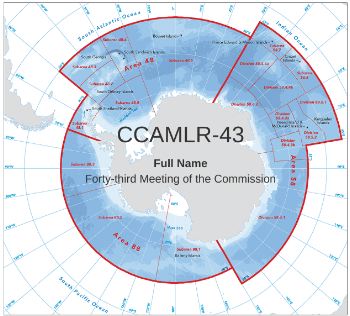
The revision of the krill management strategy for Area 48 (Atlantic Antarctica) has been a key task for CCAMLR in recent years. It involves a priority change in the approach to managing the krill fishery in the Antarctic Peninsula subarea (48.1).
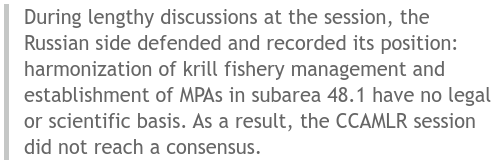
 As Fishnews was told by the press service of the All-Russian Research Institute of Fisheries and Oceanography (VNIRO), the development of krill harvesting management schemes is being carried out without sufficient scientific justification, based on the hypothesis of the ecosystem impact of the fishery. Russian scientists are particularly concerned about the position of a number of countries on the need to harmonize approaches to krill harvesting management in subarea 48.1. It is proposed to establish a marine protected area covering the Antarctic Peninsula and the southern part of the Scotia Sea arc (01 MPA). As a result, proposals are being put forward that lead to unjustified restrictions on fishing activities in bioproductive areas of the Antarctic Peninsula, VNIRO emphasized. As Fishnews was told by the press service of the All-Russian Research Institute of Fisheries and Oceanography (VNIRO), the development of krill harvesting management schemes is being carried out without sufficient scientific justification, based on the hypothesis of the ecosystem impact of the fishery. Russian scientists are particularly concerned about the position of a number of countries on the need to harmonize approaches to krill harvesting management in subarea 48.1. It is proposed to establish a marine protected area covering the Antarctic Peninsula and the southern part of the Scotia Sea arc (01 MPA). As a result, proposals are being put forward that lead to unjustified restrictions on fishing activities in bioproductive areas of the Antarctic Peninsula, VNIRO emphasized.
Currently, the permissible catch of krill in area 48 is 5.61 million tons, with a limit of 620 thousand tons at the trigger catch level (in accordance with the current conservation measure MS 51-01).
This trigger level was set until CCAMLR agreed on a way to spatially and temporally separate a much larger precautionary limit.
VNIRO noted that the validity period of MS 51-07, which established the proportional division of the trigger catch between subareas 48.1-48.4, expired this year. The commission did not reach a consensus on the extension of MS 51-07, and this measure was abolished.
Thus, in area 48 (the Antarctic part of the Atlantic), the trigger catch of krill of 620 thousand tons can be achieved with any spatial distribution of catches between subareas 48.1-48.4 under the Olympic fishing system, the scientists noted.
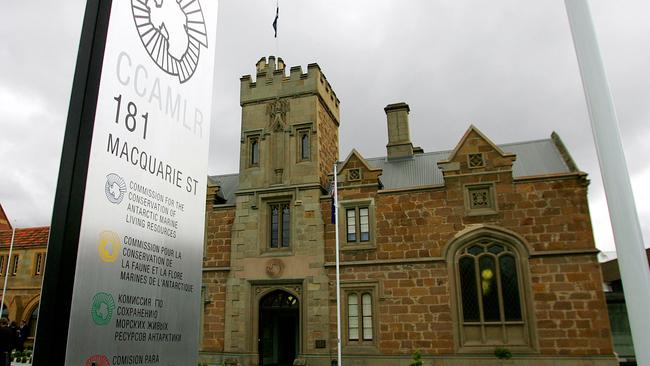
The Commission’s Headquarters are located in Hobart, Tasmania, Australia
Toothfish
The 43rd session of CCAMLR approved the catch values for toothfish in areas under national jurisdiction (in subareas 48.3, 48.4, 58.5.1, 58.5.2, 58.6) and in subareas accessible to international fishing. Including for longline vessels under the Russian flag (subarea 88.1 - 3199 tons and subarea 88.2 - 1384 tons).
The most lengthy discussion took place regarding the management of the Patagonian toothfish resource in Statistical Subarea 48.3 (South Georgia Island subarea). The Russian side reiterated its position: the population in Subarea 48.3, which is a UK marine area, needs protection, since the approach to stock management does not ensure sustainable and rational use of the resource and requires revision.
The Institute noted that the revision of the regulatory system for toothfish fisheries in the convention area remains a pressing issue for CCAMLR, requiring  clarity regarding the status of fisheries and resource scientific programs within the framework of existing conservation measures. Proposals for the classification of fisheries and scientific fishing for toothfish with subsequent determination of their status were presented by the Russian delegation and supported by the commission. clarity regarding the status of fisheries and resource scientific programs within the framework of existing conservation measures. Proposals for the classification of fisheries and scientific fishing for toothfish with subsequent determination of their status were presented by the Russian delegation and supported by the commission.
The classification of scientific catches for the Antarctic toothfish resource research program remains an issue. It was carried out in East Antarctica (subarea 58.4.1) with the participation of seven vessels from five countries. The classification issue relates to the standardization of the types of longline formations used. This program has been suspended since the 2018/2019 season due to a lack of clarity regarding its methodology and effectiveness.
Marine Protected Areas
As before, under the pretext of environmental protection goals, targeted scientifically unsubstantiated attempts are being made to establish vast MPAs that close traditional and potential areas of krill and fish fishing, VNIRO emphasized. Russia is particularly concerned about the situation with the Ross Sea Region MPA (RSRM), which has existed for 8 years without a research and monitoring plan or the necessary information support.
For the fifth year, the commission has failed to reach a consensus on establishing a unified process for the creation and operation of MPAs in the CAMLR Convention Zone. The Russian documents at the session presented a corresponding roadmap.
The results of the session show that protecting the interests of domestic fisheries in Antarctica requires regular comprehensive expeditionary research on the STM Atlantis, increasing the number of vessels in the krill and toothfish fisheries , and implementing scientific programs on the fishing fleet, the institute summarized.
[email protected]
www.seafood.media
Information of the company:
|
Address:
|
181 Macquarie St - PO Box 213
|
|
City:
|
Hobart
|
|
State/ZIP:
|
Tasmania (7000)
|
|
Country:
|
Australia
|
|
Phone:
|
+61 3 6210 1111
|
|
Fax:
|
+61 3 6224 8744
|
|
E-Mail:
|
[email protected]
|
More about: 
|
|






 Print
Print