|

CCAMLR was founded in 1982 in response to increasing commercial interest in Antarctic krill, with a mandate to conserve Antarctic marine life
New failure for the creation of three marine protected areas in Antarctica
 (ANTARCTICA, 10/30/2023)
Meeting from October 23 to 27, the Commission for the Conservation of Antarctic Marine Fauna and Flora, which brings together 26 countries and the European Union, failed to reach an agreement to establish new marine protected areas, announced on Friday 27th at the end of the day of environmental NGOs.
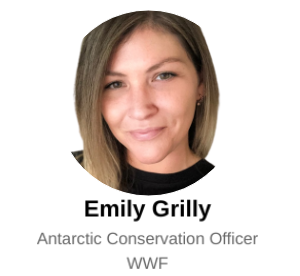 The Commission (CCAMLR), meeting in Australia for its 42nd session, failed to agree on the establishment of three new marine protected areas in Antarctica, which would have made it possible to protect human activities, in particular from krill fishing, an area of 4 million km², according to WWF and Greenpeace, while the CCALMLR had still not communicated, by the end of the day on Friday, on the results of its meeting. This project, if it had been successful, would have been the largest in the history of ocean protection. “It is frustrating that discussions on marine protected areas have continued for decades and extremely disappointing that CCAMLR has once again been unable to make significant progress, particularly after a year of unprecedented and worrying 'climate' change . for Antarctica,” said WWF Antarctic Conservation Officer Emily Grilly. The Commission (CCAMLR), meeting in Australia for its 42nd session, failed to agree on the establishment of three new marine protected areas in Antarctica, which would have made it possible to protect human activities, in particular from krill fishing, an area of 4 million km², according to WWF and Greenpeace, while the CCALMLR had still not communicated, by the end of the day on Friday, on the results of its meeting. This project, if it had been successful, would have been the largest in the history of ocean protection. “It is frustrating that discussions on marine protected areas have continued for decades and extremely disappointing that CCAMLR has once again been unable to make significant progress, particularly after a year of unprecedented and worrying 'climate' change . for Antarctica,” said WWF Antarctic Conservation Officer Emily Grilly.
The creation of a network of vast marine protected areas (MPAs), begun in 2009, has not evolved since the 2016 session , which saw the creation of an MPA of 1.57 million km² in the Sea of Ross.
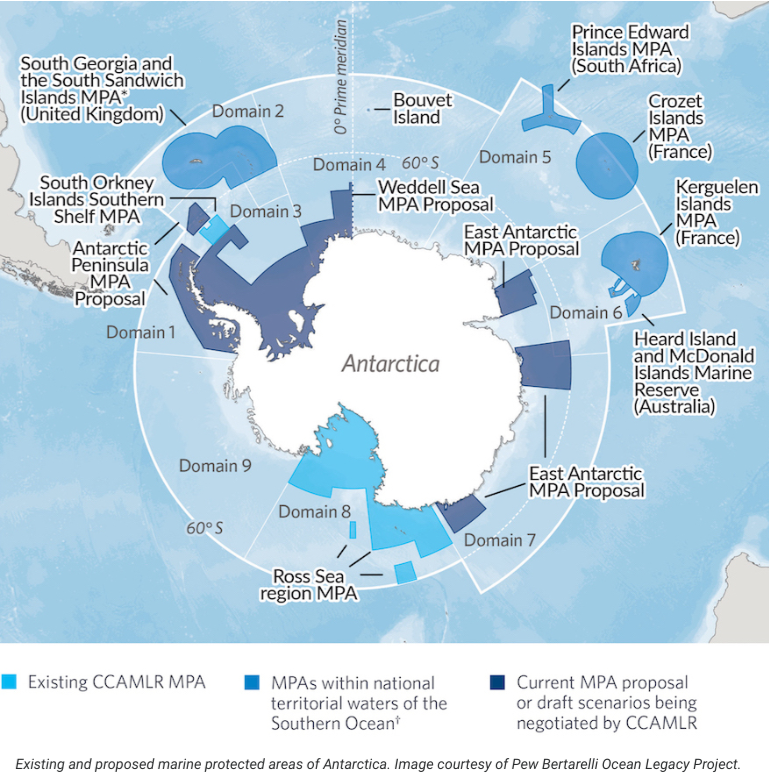
CCAMLR planning domains and marine protected areas in the Southern Ocean. CCAMLR MPA planning domains and MPAs in the Southern Ocean
The CCAMLR, which regulates fishing activities, brings together the United States, China, Russia, Great Britain, France, India and Japan. These marine protected areas were first proposed in 2010, and their size was reduced in 2017, in order to gather support from more countries. But their creation has been persistently blocked by China and Russia, who invoke fishing rights, and recently by Chile.
 The NGOs expressed the hope that the Commission would not remain inactive given the accelerated melting of Antarctic ice and “the massive deaths of vulnerable species” observed in the area. The impasse is all the more regrettable since the UN adopted a historic treaty for the protection of the high seas in June, which the first countries signed in September, to protect marine ecosystems vital to humanity, noted Greenpeace. “The Commission can still agree on new licenses for fishing, but cannot agree on the concrete means to move forward regarding protection,” regretted Jehki Harkonen, in charge of the ocean to Greenpeace International, pointing to a “new failed meeting” The NGOs expressed the hope that the Commission would not remain inactive given the accelerated melting of Antarctic ice and “the massive deaths of vulnerable species” observed in the area. The impasse is all the more regrettable since the UN adopted a historic treaty for the protection of the high seas in June, which the first countries signed in September, to protect marine ecosystems vital to humanity, noted Greenpeace. “The Commission can still agree on new licenses for fishing, but cannot agree on the concrete means to move forward regarding protection,” regretted Jehki Harkonen, in charge of the ocean to Greenpeace International, pointing to a “new failed meeting”
Source: Le Marin/AFP (translated from original in french)
[email protected]
www.seafood.media
Information of the company:
|
Address:
|
181 Macquarie St - PO Box 213
|
|
City:
|
Hobart
|
|
State/ZIP:
|
Tasmania (7000)
|
|
Country:
|
Australia
|
|
Phone:
|
+61 3 6210 1111
|
|
Fax:
|
+61 3 6224 8744
|
|
E-Mail:
|
[email protected]
|
More about: 
|
|






 Print
Print