|
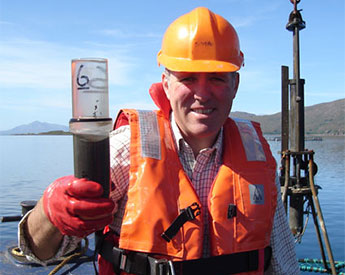
Professor Kenny Black. (Photo: SAMS)
Merck and Scottish Govt involved in collusion suspicions
 (UNITED KINGDOM, 6/7/2017)
Multinational Merck is suspected to have hired reviewers to criticise evidence in a scientific study that the company’s salmon farm chemical was causing widespread environmental damage, as it was reported by The Sunday Herald.
The newspaper uncovered that the Scottish Government allowed the US drug company, which manufactures a pesticide containing emamectin benzoate to kill the sea lice that plague caged salmon, to secretly rubbish the scientific study blaming one of its pesticides for killing wildlife in Scottish sea lochs.
The scientists behind the study and the Scottish Environment Protection Agency (Sepa) privately protested about Merck’s involvement, but government and salmon industry officials insisted that the company’s role should be kept secret, according to the Scottish newspaper.
Merck’s behind-the-scenes influence has been exposed by more than 70 megabytes of internal documents released by the Crown Estate under freedom of information law. They also show that government and industry agreed not to issue a press release on the study.
The revelations have been described as “extraordinary” by environmentalists, who are demanding a ban on the pesticide.
According to the newspaper, central to the saga is a study carried out by the Scottish Association for Marine Science (SAMS) in Oban for the charity Scottish Aquaculture Research Forum (SARF), funded by the Scottish Government and the fish farming industry to support a “sustainable” fish farming industry.
The study, which was posted online in August 2016, suggested that emamectin contamination of the seabed was causing “substantial, wide-scale reductions” in crabs, lobsters and other crustaceans.
But it was contained within a second report that cast major doubts on its findings, which was said to have been the result of concerns from “independent” but unnamed referees. But internal communications name Merck as responsible for the criticisms.
In a 25-page response to the criticisms in December 2015 Professor Kenny Black and Dr Tom Wilding from SAMS said that four of the five reviewers were “from Merck”.
Furthermore, in emails to SARF they expressed concern that refusing to admit the company’s role “might reflect negatively” on the review “if/when this information becomes public.”
On the other hand, Merck’s UK arm, MSD Animal Health, stressed the value of emamectin in controlling sea lice, and its support for high quality research.
Meanwhile, the Scottish Government highlighted its commitment to “sustainable growth” of the fish farming industry. And a spokesperson ensured that "it is usual for the scientific work reviewers to be anonymous and to hire several reviewers for the process to be robust.
The Scottish salmon industry argued that in its opinion the SAMS study was inconclusive.
[email protected]
www.seafood.media
Information of the company:
|
Address:
|
2000 Galloping Hill Road
|
|
City:
|
Kenilworth,
|
|
State/ZIP:
|
New Jersey (NJ J 07033)
|
|
Country:
|
United States
|
|
Phone:
|
+1 908-298 4000
|
|
Fax:
|
+1 908-298 7082
|
More about: 
|
|
|
|







 Print
Print