|

The Fish Stocks Agreement stipulates that 'States shall apply the precautionary approach widely...in order to protect the living marine resources..'
Governments Make Progress on United Nations Fish Stocks Agreement
 (WORLDWIDE, 5/22/2023)
The following is an excerpt from an article published by The Pew Charitable Trusts:
Tuna RFMOs have implemented some key provisions, but ecosystem protections, accountability lag
Overview
The United Nations Fish Stocks Agreement (UNFSA) has governed worldwide “long-term conservation and sustainable use” of shared fish stocks—those that bridge the legal boundaries separating the waters of nations, mainly tunas and sharks—since 2001.1 Yet more than 20 years on, a new analysis from The Pew Charitable Trusts finds that, despite some notable progress, countries still are not meeting important legal obligations under the agreement, even as advances in scientific knowledge present critical opportunities to update UNFSA’s decades- old provisions.
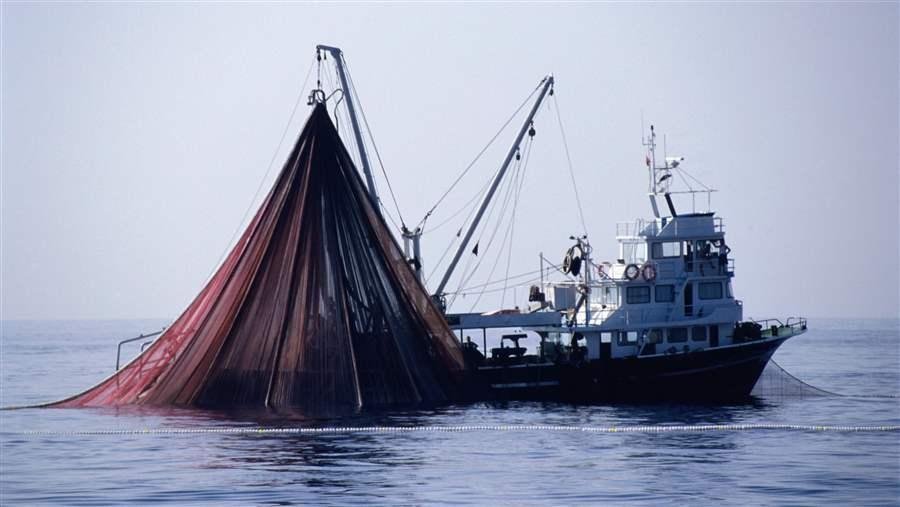
 The UNFSA directs countries to cooperate to ensure that shared stocks are fished sustainably, according to the best science available, and to use an ecosystem-based management approach that accounts for these species’ value in the ocean’s broader web of life. Governments, in turn, pursue those collaborations through membership in regional fisheries management organizations (RFMOs), the international bodies empowered to manage shared fish populations. The UNFSA directs countries to cooperate to ensure that shared stocks are fished sustainably, according to the best science available, and to use an ecosystem-based management approach that accounts for these species’ value in the ocean’s broader web of life. Governments, in turn, pursue those collaborations through membership in regional fisheries management organizations (RFMOs), the international bodies empowered to manage shared fish populations.
Ahead of the 2016 review conference held on the 15th anniversary of the agreement’s entry into force, Pew conducted an independent assessment of implementation of the UNFSA provisions. That study found that RFMOs were largely failing their management obligations, except in efforts to tackle illegal, unreported and unregulated (IUU) fishing.2 At that time, RFMOs and their Member States had done only modest work to move fish stocks towards science-based harvest strategies, overfishing remained a global problem, and countries still largely ignored ecosystem considerations for species such as sharks.
 In the intervening years, support has grown among parties to the agreement for a range of science-driven updates to the UNFSA provisions, particularly through new mandates for science-based approaches, such as harvest strategies, to managing fish stocks; for implementation of ecosystem-based management; and for incorporation of climate change impacts into RFMO practices. RFMOs should also enhance compliance regimes to align them with suggested improvements under consideration by the Resumed Review Conference.3 Additional approaches to sustainable management, including measures to protect biodiversity, such as marine protected areas (MPAs) and other effective area-based conservation measures, known as OECMs, also are garnering increased support and have been the focal points of discussion in other international forums. In the intervening years, support has grown among parties to the agreement for a range of science-driven updates to the UNFSA provisions, particularly through new mandates for science-based approaches, such as harvest strategies, to managing fish stocks; for implementation of ecosystem-based management; and for incorporation of climate change impacts into RFMO practices. RFMOs should also enhance compliance regimes to align them with suggested improvements under consideration by the Resumed Review Conference.3 Additional approaches to sustainable management, including measures to protect biodiversity, such as marine protected areas (MPAs) and other effective area-based conservation measures, known as OECMs, also are garnering increased support and have been the focal points of discussion in other international forums.
In early 2023, the UN concluded negotiations on the text of an agreement to establish a new intergovernmental organization charged with the conservation and sustainable use of marine biodiversity on the high seas—that is, areas of the ocean that are beyond national jurisdiction. This new body will be empowered to establish comprehensive MPAs, and the agreement lays out a process, standards and guidelines for assessing the environmental impact of new exploratory activities not covered by current governance structures and undertaken outside of national jurisdictions.4
Additionally, this high seas agreement provides a platform to bring together multiple stakeholders, including RFMOs, for conservation and management to ensure the effectiveness and implementation of MPAs and the management measures that will underpin them. Establishment of comprehensive MPAs is not the primary function of any RFMO. However, by cooperating with the new high seas body, RFMOs can not only support effective management of the species under their jurisdiction, but also help Member States fulfil their wider conservation obligations, such as the Convention on Biological Diversity Global Biodiversity Framework.5
The new high seas agreement presents an opportunity for governments across the globe to consider marine biodiversity more holistically. For example, scientists or scientific bodies can identify non-fishing activities that jeopardize the health of fish stocks, and RFMOs can then act to mitigate the threats—in collaboration with the new high seas organization—as part of RFMOs’ wider move towards ecosystem-based fisheries management.
Now, as the parties to the UNFSA prepare for the next Resumed Review meeting, Pew has again examined the progress that RFMOs and their Member States have made since 2016 in implementing the most critical provisions of the Fish Stocks Agreement. The analysis is based on a review of the status of key tuna stocks and of the management measures across the five tuna RFMOs: the Commission for the Conservation of Southern Bluefin Tuna (CCSBT), the Inter-American Tropical Tuna Commission (IATTC), the International Commission for the Conservation of Atlantic Tunas (ICCAT), the Indian Ocean Tuna Commission (IOTC) and the Western and Central Pacific Fisheries Commission (WCPFC)... [continues]
Author/Source: Grantly Galland | Read the full article by clicking the link here
[email protected]
www.seafood.media
Information of the company:
|
Address:
|
One Commerce Square, 2005 Market Street - Suite 1700
|
|
City:
|
Philadelphia
|
|
State/ZIP:
|
Pennsylvania (PA 19103)
|
|
Country:
|
United States
|
|
Phone:
|
+1 215 575 9050
|
|
Fax:
|
+1 215 575 4939
|
|
E-Mail:
|
[email protected]
|
More about: 
|
|
|
|








 Print
Print