|
Image: NOAA / FIS
For the First Time, Scientists Can Predict Traits for All Fish Worldwide
 (UNITED STATES, 4/7/2023)
New research takes a “Robin Hood” approach to provide missing information on data-poor fish species for more effective ecosystem based fisheries management.
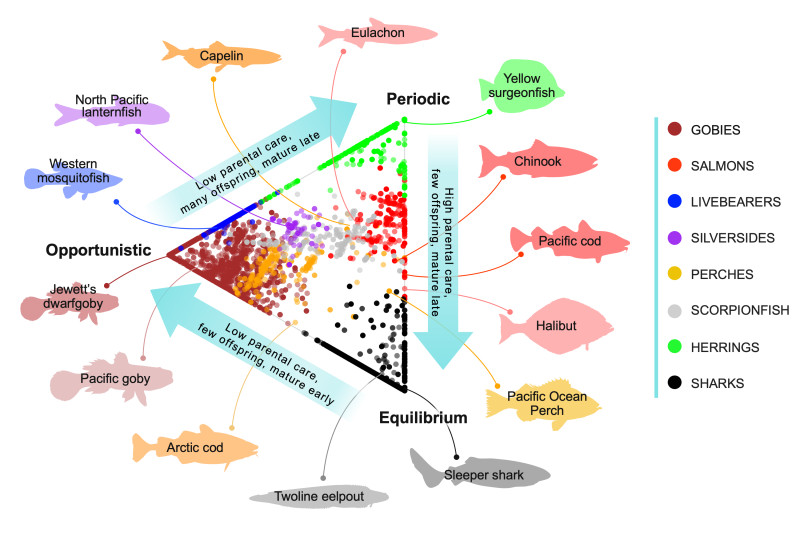
Model results showing where fish species (circles, with examples shown around perimeter) within each family or class (colors, legend on right) fall among three life-history strategies (periodic, opportunistic, and equilibrium) based on their traits. Credit: NOAA Fisheries
Scientists can now predict growth, survival, and reproductive strategies for all known fish in the world. The combination of traits a given species has developed to adapt to its niche and environment makes up its life history strategy. The new model uses 33 traits—describing size, growth, reproduction, parental care, lifespan and more— to classify more than 34,000 fish species among three dominant strategy types.
The model uses relationships among these traits from species we know a lot about to predict strategies for data-poor species. The results will inform ecosystem-based fisheries management, help forecast consequences of climate change, and advance our understanding of evolutionary relationships. This model was developed by an international team led by Jim Thorson with the NOAA Fisheries Alaska Fisheries Science Center.
 “Because of limited scientific resources, we can assess only a fraction of the fish species we catch around the world. Now we have a model that can predict traits and strategies for all the rest,” Thorson said. “That information is essential to set sustainable fishing limits and prepare for future change.” “Because of limited scientific resources, we can assess only a fraction of the fish species we catch around the world. Now we have a model that can predict traits and strategies for all the rest,” Thorson said. “That information is essential to set sustainable fishing limits and prepare for future change.”
Traits and Tradeoffs
A species’ traits were shaped by its past environment—and are key to predicting how it will respond to future environmental change.
Traits like body size, level of parental care, and longevity reflect the tradeoffs species make between growth, reproduction, and survival.
“All species traits are the result of tradeoffs among these things,” Thorson said. “That’s how we end up with a short-lived guppy that reproduces early and often, versus a shark that lives 20 years, versus a rockfish that doesn’t begin spawning for decades and lives 100 years.”
Since the 1990s, researchers have categorized fishes among three dominant life history strategies.
Opportunistic species are adapted to colonize unstable environments. They mature early, have few offspring, and invest little parental care.
Periodic species exploit somewhat more stable environments, like those with seasonal changes. They mature late, produce many offspring, and provide little parental care.
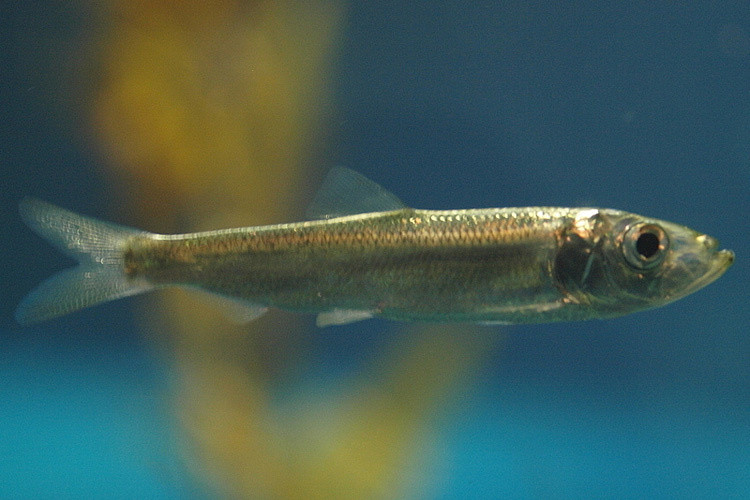
Pacific Herring have evolved a periodic life history strategy. Credit: NOAA Fisheries.
Equilibrium species thrive in highly stable environments with high levels of competition and predation. They mature late, have few offspring, and a high level of parental care.
However, this is the first study to assign all described fish to these three strategies. Accurate information on the traits and strategy of a species is essential to set sustainable catch limits and predict responses to environmental change.
“The hardest part of stock assessment is setting the biological reference point: how much can we fish a species? Knowing how many fish there are is not enough. We need to know how quickly they reproduce and how sensitive they are to change,” said Thorson. “Understanding traits and life strategies gives us a reference point for sustainable catch now and in the future. Knowing traits of the fish we manage is mandated for fisheries stock assessment improvement, but not all traits can be assessed for all species. This research fills those gaps.”
 Filling in the Missing Traits: A Robin Hood Approach Filling in the Missing Traits: A Robin Hood Approach
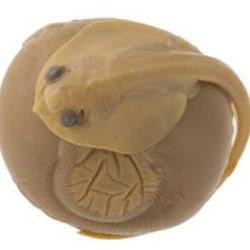
<-- Skate embryo. Sharks and skates are equilibrium species that invest a lot of effort into producing a small number of highly developed young. Credit: NOAA Fisheries.
The model included 33 variables representing life cycle, reproductive, size, and behavioral traits for all 34,000-plus known fish species worldwide. Using relationships between measured traits known from assessed species, it predicted missing traits for other species.
“We’re using a Robin Hood approach—steal from the data-rich fish, give to the data-poor,” said Thorson, “Our study extends the approach to life-history theory.”
The team then used these traits to classify all fishes among the three life strategy categories. They modeled the effects of increased temperature on fish communities. And they produced the most complete “tree of life” to date (a record of when all species evolved from their nearest ancestors) that included both bony fish and sharks. “People who study evolution have been working toward that for decades,” Thorson said.
“For the first time, we can look at the trade offs all species make between growth and reproduction, and what that means for their survival in a changing environment,” Thorson said.
Improving Assessments, Predicting Climate Impacts, and Enhancing Evolutionary Understanding

Hypothetical example involving fish responses to temperature, assuming that temperature affects body size, which in turn affects other traits. The larger the circle, the greater the correlation between traits. In this example, body size is highly correlated with temperature, and caudal fin dimensions are closely related to body size. Credit: NOAA Fisheries.
Applications and benefits of the research are myriad.
The model provides more information to accurately assess sustainable catch limits for more effective fisheries management.
“You can measure the size of a fish and from that predict what proportion you can sustainably catch per year,” Thorson said. “If you also know that that fish guards its young or that it lives in the deep-sea environment, that gives you more information about what proportion you can catch.”
It enhances our understanding of why fish have particular combinations of traits.
“We can answer why some fish have more parental investment. Our case study agrees with recent theoretical predictions that fish with very small adult body sizes will be more likely to guard their young,” Thorson said. “As fish get smaller they shrink their babies—but not beyond the size of their retina. At that point they have to take better care of them. Our model corroborates this.”
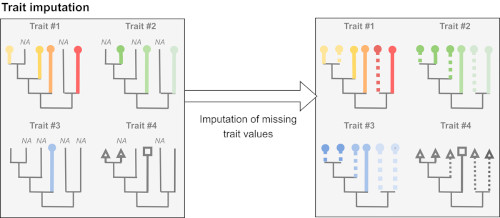
Analyses start by assembling trait measurements. In this example, trait values are available for some but not all of six species. Associations among traits are used to generate a prediction of missing traits for each fish species. Colored lines represent traits that are measured; grey lines show missing trait values. Credit: NOAA Fisheries.
This kind of knowledge can prevent the use of trait combinations that are highly unlikely or biologically implausible in stock assessment. For example, it would prevent estimating high mortality in combination with large maximum body size.
The model advances our ability to predict impacts of climate change. Besides improving knowledge of many species traits, it provides the capability to include hundreds of fish species simultaneously in ecosystem models. Global results suggest that a 1-degree Celsius increase in temperature is associated with an average 3.5 percent increase in mortality and 3 percent decrease in fecundity (through indirect impacts on maximum age and length) on evolutionary time-scales.
The model is currently being used in Alaska to improve estimates of natural mortality for rockfish. “Rockfish are small but long-lived—that’s not what we would usually expect. They are able to remain small because they have developed defenses like spines. Our model captures that aspect of their life strategy.”

Evaluating predictive performance for all variables based on a four-fold cross-validation experiment. For continuous-valued traits, plots show the held-out value (x-axis) against the predicted value (y-axis), along with the one-to-one line (black line) and list the percent-variance-explained (PVE). A well-performing model will have predictions near the one-to-one line and a PVE approaching 100%. For discrete-valued traits, we used the held-out factor-level indicator (0 or 1) and the predicted class probability to calculate the receiver-operator characteristics curve (ROC). A well-performing model will have ROC in the upper-left corner and an AUC approaching 1.0.Source: NOAA
It is also being used worldwide for more data-poor species. The model has been used by the Food and Agriculture Organization of the United Nations, the International Council for the Exploration of the Sea, and throughout the Pacific Ocean.
And Thorson says the model has wide relevance beyond fish: ”We could do this for crab, coral, or octopus. It could be used for terrestrial ecosystems to look at insects, mammals, and birds. It also could be used to combine experimental and observation approaches to studying evolution. We’re already using it to understand how traits affect habitat selection. Traits are how genes affect fitness, so studying traits is central across the entire tree of life.“
Source NOAA Fisheries
[email protected]
www.seafood.media
Information of the company:
|
Address:
|
14th Street & Constitution Avenue - NW Room 6013
|
|
City:
|
Washington, DC
|
|
State/ZIP:
|
(20230-0001)
|
|
Country:
|
United States
|
|
Phone:
|
+1 202 482 6090
|
|
Fax:
|
+1 202 482 3154
|
|
E-Mail:
|
[email protected]
|
More about: 
|
|
|
|







 Print
Print