|
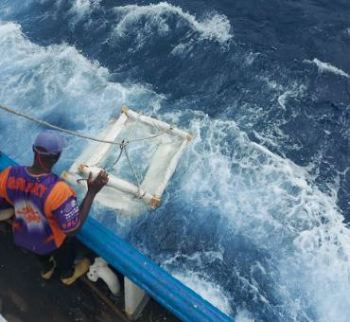
The OPAGAC fleet uses adrift FADs, which move with ocean currents.
The Spanish tuna fleet already has biodegradable FAD projects in three oceans
 (SPAIN, 12/10/2021)
After the start-up of a new project in the Atlantic that will evaluate the viability of using organic materials for its construction
Madrid - The Spanish tuna fleet leads the research and development of biodegradable FADs (fish ggregating devices) on a world scale, after the pilot started this year in the Atlantic Ocean and which makes our fleet the only one with projects of this type in the three oceans in which it operates.
.jpg) Like the research carried out in the Indian and Pacific since 2017 and 2019, respectively, the one now started in the Atlantic will evaluate during 2022 the viability of these biodegradable FADs under real conditions of use, as well as their contribution to reducing pollution. Marine. The results of these experiments will allow the fleet to have practical evidence for the subsequent implementation of these FADs in a generalized way in all oceans. Like the research carried out in the Indian and Pacific since 2017 and 2019, respectively, the one now started in the Atlantic will evaluate during 2022 the viability of these biodegradable FADs under real conditions of use, as well as their contribution to reducing pollution. Marine. The results of these experiments will allow the fleet to have practical evidence for the subsequent implementation of these FADs in a generalized way in all oceans.
With this work, our fleet looks for biodegradable alternatives to synthetic materials, to minimize their impact on the ecosystem, especially in the event of loss due to sinking or stranding. For this, the fleet grouped in OPAGAC tests, in collaboration with various entities (such as AZTI and ISSF), the durability and biodegradability of organic materials, including wood, fabric, bamboo and ropes of plant origin. Likewise, it analyzes the capacity of biodegradable FADs to concentrate tuna and their drift patterns, which are essential to maintain fishing activity, simultaneously minimizing their interaction with vulnerable marine ecosystems.
The ultimate goal is to design a type of FAD with as much biodegradable material as possible, in a proportion that does not affect the function of these devices and eliminates the risk of associated fauna gillnets.
.jpeg)
On the other hand, the fleet also points out that the date that some NGOs are establishing as a limit to adopt 100% biodegradable FAD (end of this year) is not feasible, given the limitations that still exist from various points of view, such as the biodegradability of the materials, the effectiveness of the designs or their economic viability. In this regard, it should be noted that, for the time being, the Regional Fisheries Organizations (RFOs) in charge of regulating tuna fishing have adopted recommendations and resolutions to promote research and the use of biodegradable materials in the construction of FADs.
.jpeg) According to Julio Morón managing director of the Organization of Associated Producers of Large Freezer Tuna Boats (OPAGAC), “the use of FAD to facilitate the concentration of tropical tunas is a centuries-old fishing technique that we want to evolve according to the new environment in which sustainability is a fundamental variable. For this reason, we are developing this new generation of FAD - Morón adds -, which must also be sufficiently durable, according to the varying needs of each fleet and fishing area, be manufactured with easily accessible materials and have a reasonable cost ”. According to Julio Morón managing director of the Organization of Associated Producers of Large Freezer Tuna Boats (OPAGAC), “the use of FAD to facilitate the concentration of tropical tunas is a centuries-old fishing technique that we want to evolve according to the new environment in which sustainability is a fundamental variable. For this reason, we are developing this new generation of FAD - Morón adds -, which must also be sufficiently durable, according to the varying needs of each fleet and fishing area, be manufactured with easily accessible materials and have a reasonable cost ”.
The tuna fleet frames this research work in its continuous work to improve the fishery, to guarantee a more sustainable fishing and with the least impact on the ecosystem, along with other measures such as the training of the crew in techniques of handling and release of non-target species.
The OPAGAC fleet uses adrift FADs, which move with ocean currents.
[email protected]
www.seafood.media
Information of the company:
|
Address:
|
C/ Ayala 54
|
|
City:
|
Madrid
|
|
State/ZIP:
|
(28001)
|
|
Country:
|
Spain
|
|
Phone:
|
+34 91 5758 959
|
|
Fax:
|
+34 91 5758 959
|
|
E-Mail:
|
[email protected]
|
More about: 
|
|
|






 Print
Print