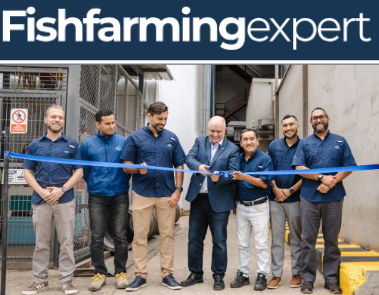
Other Media | fishfarmingexpert: Fishmeal supply plunged by 49% in first seven months of 2026
WORLDWIDE
Tuesday, September 15, 2026
The volume of fishmeal produced globally during the first seven months of this year was 49% behind the same period in 2025, while fish oil output was down 30%, marine ingredients organisation IFFO said today.
Smaller forage fish volumes in Peru and Chile remained the biggest cause of the shortfall, with softer catches in the African countries and Northern Europe compounding the global decline.
Source: fishfarmingexpert | Read the full article here
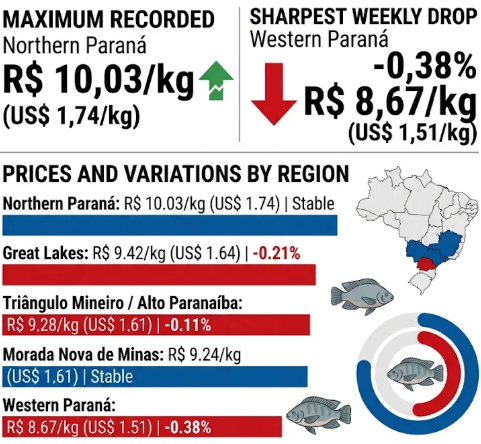
Western Paraná registers the largest weekly drop, of 0.38%
Farm-gate prices for Nile tilapia (Oreochromis niloticus) registered minor fluctuations across major Brazilian producing regions monitored by the Center for Advanced Studies in Applied Economics (Cepea) during the week of November 2nd to 6th, 2026.
Western Paraná recorded the sharpest weekly drop, easing 0.38% compared to the previous week to stand at R$ 8.67 (US$ 1.51) per kilogram. Downward adjustments were also observed in the Great Lakes region, where prices fell 0.21% to R$ 9.42 (US$ 1.64)/kg, and in Triângulo Mineiro and Alto Paranaíba, which slipped 0.11% to R$ 9.28 (US$ 1.61)/kg.
Conversely, values held firm across other monitored basins. Quotes in Morada Nova de Minas remained stable at R$ 9.24 (US$ 1.61)/kg, while Northern Paraná commanded the market peak at R$ 10.03 (US$ 1.74)/kg, according to official benchmark data compiled by Cepea.
Strengthening the protection of farming sites and advancing in stages toward an open-ocean pilot project are the primary proposals of the executive report, “Oceanic Aquaculture in Chile: El Niño 2026–2027 and the Challenge of Naval Architecture,” prepared by engineer Rene Pallalever P. The document addresses environmental risks to salmon farming, as well as the technical, regulatory, and operational conditions required for the development of oceanic aquaculture.
The analysis synthesizes scientific literature, industry background information, and climate forecasts to propose a strategy for gradual investment.
The Galician town of Burela will host a special event on November 22 featuring a documentary premiere, discussions on maritime heritage and a seafood tasting to highlight the importance of fishing traditions and local products.
The Expomar Foundation will celebrate World Fisheries Day on Sunday, November 22, in Burela, Galicia, Spain, with a programme combining culture, maritime identity and gastronomy. The initiative, supported by the Galician Regional Government's Department of the Sea and the Burela City Council, commemorates the international observance held annually on November 21.
Source: Industrias Pesqueras | Read the full article here
The African nation identifies the expiration of the protocol as the "primary source of uncertainty" regarding fisheries-related revenue; nonetheless, it projects a 1% increase in such income, reaching 224 million.
The Mauritanian government expects to boost revenue from the fisheries sector by nearly 29% compared to 2025, though the impending expiration of the fisheries protocol with the European Union casts doubt on whether these budgetary targets can be met. The current fisheries protocol between Mauritania and the European Union stands as one of the most significant international agreements for the EU fishing fleet.
The agreement authorizes European vessels to operate in Mauritanian waters and catch various species—including small pelagics, tuna, crustaceans, and demersal species—with an annual catch limit of up to 280,050 tonnes.
Author: Jorge Garnelo / Faro de Vigo | Read the full article here
U.K. seafood brand Young’s is adding to its Gastro range of products, capitalizing on the nation’s growing acceptance of and preference for basa, also referred to as pangasius.
According to Sofina Foods Europe Seafood Marketing Director Kevin Sinfield, Young's was the first major brand to introduce basa to U.K. consumers back in 2008, and now, the fish has become the seventh most consumed species in the country.
Young’s Gastro range, now worth GBP 69.5 million (USD 93.5 million, EUR 83.3 million), has prominently featured basa for many years.
Author: Christine Blank / SeafoodSource | Read the full article here
New regulations on nets and selective fishing gear are set to be introduced in UK and EU waters to protect stocks.
The changes have been made through fishing licence conditions after the UK and EU reached an agreement on a package of technical fisheries measures aimed at rebuilding depleted stocks in the Celtic Sea, English Channel and Irish Sea.
At the heart of the agreement is a requirement for fishermen to use larger mesh sizes and more selective fishing gear.
The licence conditions were brought in on 1 November and come into force from 26 November.
The harvesting of these two species is carried out primarily by the artisanal fishing fleet
The Galician fleet will resume the harvesting of spider crab and brown crab today, now that the closed seasons for each species have ended. This was announced yesterday by the Xunta (Galician regional government) in a statement, which noted that, as of this Monday, the closed season—established under the 2026–2027 experimental management plan for these species, approved by the Department of Marine Affairs—has come to an end.
In the case of the spider crab, fishing will resume in zones A and B, which span from the mouth of the Miño River to Cape Corrubedo, and from that point to Estaca de Bares, respectively.
Source: La Voz de Galicia | Read the full article here
AKVA group, the world’s largest supplier of technology equipment and services to the global aquaculture industry, became a Japanese business today.
AKVA said in an Oslo Stock Exchange announcement today that that the Japanese industrial group Yanmar has acquired just over 92% of the outstanding shares in the Norwegian company, in a deal worth £466 million. This is more than the 90% required as a condition for compulsory redemption of the remaining shareholders.Yanmar said that it plans to carry out such a forced redemption, securing 100% of the shares in the business.
Author: Vince McDonagh /Fish Farmer | Read the full article here
Japanese seafood group Nissui has reported a slower-than-expected recovery at its recently acquired Chilean salmon business, as disease and poor growing conditions push up costs.
The company, which bought Chilean producer Pesquera Yadran for $133 million in January, said fish disease and low oxygen levels had caused higher mortality and slower growth at some farms.
The problems have reduced profits from Nissui's South American salmon operations, although the company expects conditions to improve before the end of the year.
Source: SalmonBusiness | Read the full article here
BioMar Ecuador has inaugurated the first phase of its production expansion project, strengthening its manufacturing capacity to support the growing demand for shrimp feed in Ecuador.
The inauguration took place on October 29 and marks another step in BioMar's continued investment in the Ecuadorian aquaculture industry, the company said in a press release.The inauguration follows BioMar’s announcement earlier this year of plans to increase production capacity at its Ecuadorian facility from 300,000 to 410,000 tonnes during 2026
Source: fishfarmingexpert | Read the full article here




 WORLDWIDE
.png) The volume of fishmeal produced globally during the first seven months of this year was 49% behind the same period in 2025, while fish oil output was down 30%, marine ingredients organisation
 BRAZIL
 CHILE
 Strengthening the protection of farming sites and advancing in stages toward an open-ocean pilot project are the primary proposals of the executive report, “Oceanic Aquaculture in Chile: El Niño 2026–2027 and the Challenge of Naval Architecture,” prepared by engineer Rene Pallalever P. The document addresses environmental risks to salmon farming, as well as the technical, regulatory, and operational conditions required for the development of oceanic aquaculture.
 SPAIN
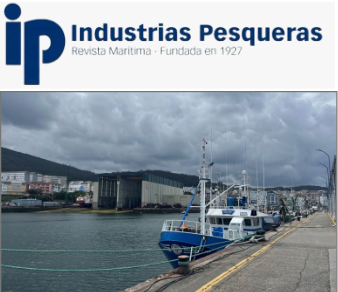 The Galician town of Burela will host a special event on November 22 featuring a documentary premiere, discussions on maritime heritage and a seafood tasting to highlight the importance of fishing traditions and local products.
 MAURITANIA
.png)
 UNITED KINGDOM
 U.K. seafood brand
.png) New regulations on nets and selective fishing gear are set to be introduced in UK and EU waters to protect stocks.
.png) The Galician fleet will resume the harvesting of spider crab and brown crab today, now that the closed seasons for each species have ended. This was announced yesterday by the Xunta (Galician regional government) in a statement, which noted that, as of this Monday, the closed season—established under the 2026–2027 experimental management plan for these species, approved by the Department of Marine Affairs—has come to an end.
 JAPAN

.png) Japanese seafood group
 ECUADOR