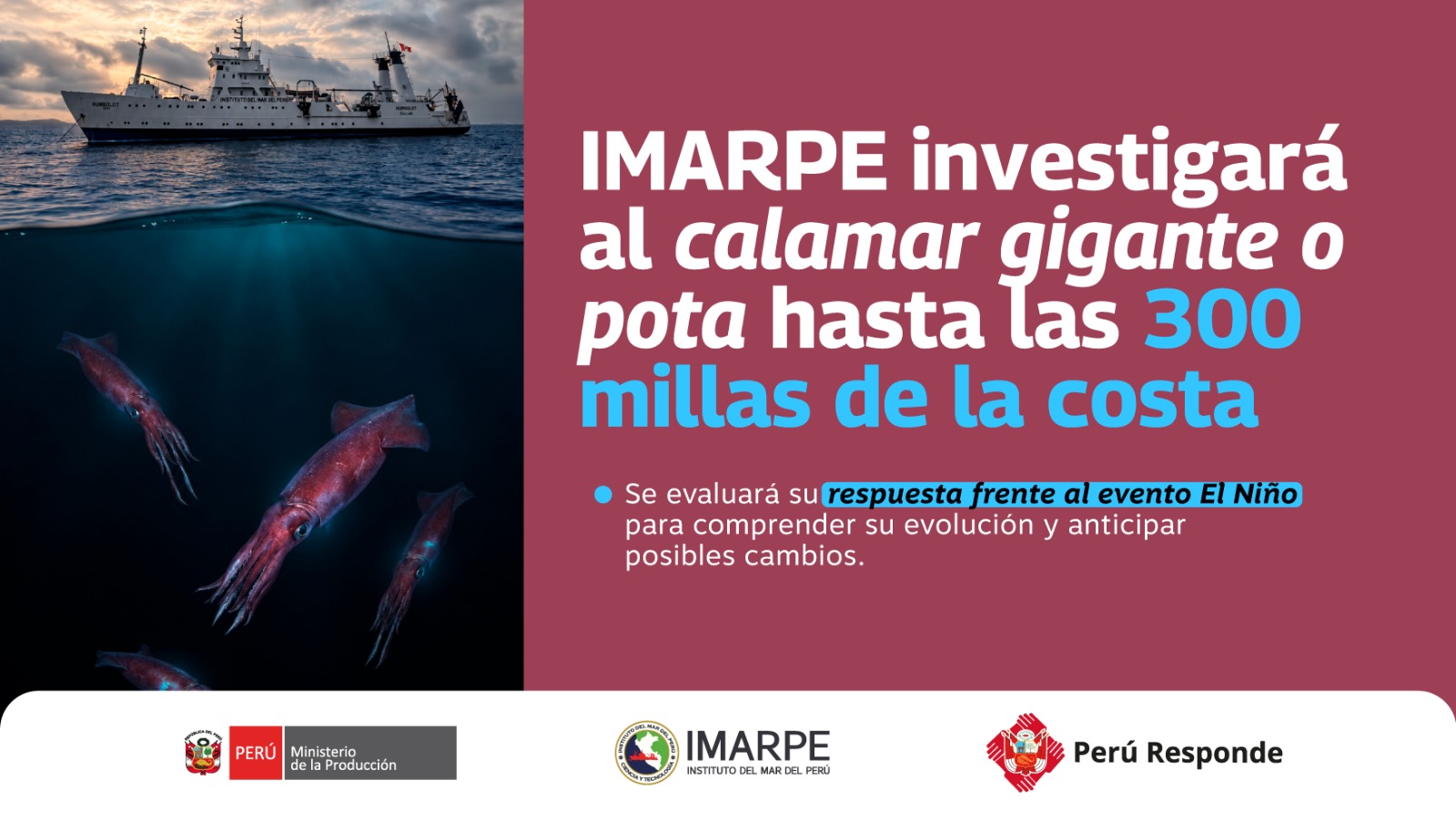
The Peruvian Marine Research Institute (IMARPE), an agency attached to the Ministry of Production (PRODUCE), is conducting the Jumbo Flying Squid (Dosidicus gigas) Research Cruise aboard the RV Humboldt from November 4 through December 15, 2026. The scientific campaign is assessing the distribution, relative abundance, and biological status of the resource in the context of the 2026-2027 El Niño event.
The expedition covers the coastline from Ilo to Paita, between 20 and 300 nautical miles offshore, operating up to the outer limit in coordination with the South Pacific Regional Fisheries Management Organisation (SPRFMO).
Using acoustic methods and fishing gear, specialists in biology, oceanography, and acoustics are analyzing size structures and the species' response to thermal variations and water masses. As Peru's second-largest hydrobiological resource and a pillar of the artisanal fleet and direct human consumption, the collected data will support catch projections and fishery management measures for 2027.
An 18-month project aims to cut costs and improve production efficiency.
The Ministry of Fisheries and Sultan Qaboos University will develop an AI-based system using underwater imaging to estimate fish biomass, analyse feeding behaviour and automate feeding.
Feed accounts for 50-70% of fish farms' operating costs.
The Northwestern Sri Lanka blue swimming crab fishery has achieved certification to the Marine Stewardship Council (MSC) standard, marking a first for the country, after over a decade of work.
The MSC announced the certification, which covers the wild capture of Portunus pelagicus, will apply to fishing in two areas off Sri Lanka’s northwestern coast in Palk Bay and the Gulf of Mannar. The certification follows a fishery improvement project (FIP) and covers small-scale fishers using bottom-set gillnets using traditional boats and small motorized vessels. The Seafood Exporters’ Association of Sri Lanka, with support from the then-U.S. National Fisheries Institute (now National Seafood Association) Crab Council, helped start the certification process in 2013 by bringing together stakeholders to work on improving the scientific data available on the blue swimming crab stock.
Author: Chris Chase / SeafoodSource | Read the full article here
Cage aquaculture boosts tourism and local incomes.
In Koh Yao Noi, Phang Nga, fishermen raise seven-colour spiny lobsters for 8-12 months, starting with 200-300 g juveniles.
Sold at 2,800 baht/kg to restaurants and hotels, production cannot meet demand. Cage farms also attract tourists, creating additional income for coastal communities.
A marine mapping service for the fishing industry has undergone significant upgrades, improving access to critical information for fishers, regulators and maritime stakeholders.
The recent major data refresh and full system upgrade made to Seafish’s Kingfisher Restrictions website ensures the platform reflects the most accurate and up-to-date spatial information available and shows exactly where gear-based fishing restrictions exist around the UK.
Thanks to the refresh, users now have access to improved data quality from 16 fisheries regulators across the UK, faster system performance, added download functions and updated plotter files.
Jaime Letelier highlighted ocean variability challenges at the 4th GRASP Workshop.
On November 4, IFOP presented how El Niño 2026 affects biomass distribution and fishing operations in Chile.
Experts from Japan, Ecuador, Colombia and Peru discussed ocean monitoring, climate anomalies and sustainable fisheries management in the Southeast Pacific.
The inclusion of research led by IFOP underscores Chile’s strategic role in monitoring climate anomalies, fostering the interoperability of oceanographic data across the region, and advancing biophysical modeling to support sustainable decision-making in the fisheries sector.
The 2026 Aquatic Products Conference strengthens international cooperation.
Held on November 2 in Shandong, the event featured 2 plenary sessions and 9 thematic forums on trade, innovation and digitalisation. Weihai signed an agreement to develop a global distribution hub for live and fresh seafood, boosting international trade and industry competitiveness.
Brussels aims to rebuild stocks and ensure sustainable fisheries.
The European Commission proposes catch limits for 11 stocks in the Atlantic, Kattegat and Skagerrak.
It recommends cuts for hake (-20%), sole (-15%) and red seabream (-35%), while increasing anglerfish (+22%) and horse mackerel (+6%) quotas, based on ICES scientific advice.
Norway Pelagic Fisheries Report, Week 44 Norway
Historic Herring Fishing Surge in Altafjord with Massive Landings
The Norwegian fleet concentrates operations in the north as the annual quota enters its final stretch alongside supplementary landing...



 GHANA
 PERU
 OMAN
 An 18-month project aims to cut costs and improve production efficiency.
 SRI LANKA
.png) The Northwestern Sri Lanka blue swimming crab fishery has achieved certification to the
 THAILAND
.png) Cage aquaculture boosts tourism and local incomes.
 TURKEY
 UNITED KINGDOM
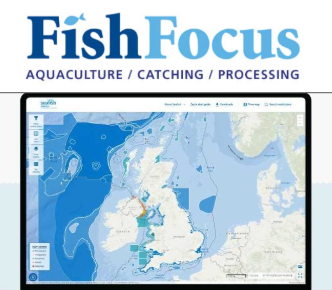 A marine mapping service for the fishing industry has undergone significant upgrades, improving access to critical information for fishers, regulators and maritime stakeholders.
 CHILE
.png) Jaime Letelier highlighted ocean variability challenges at the 4th GRASP Workshop.
 CHINA
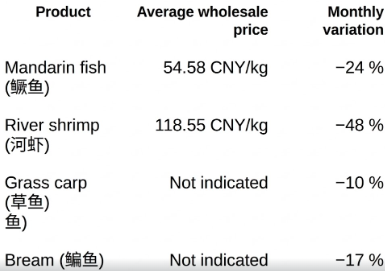
 The 2026 Aquatic Products Conference strengthens international cooperation.
 EUROPEAN UNION
 Brussels aims to rebuild stocks and ensure sustainable fisheries.