IN BRIEF - Vietnam’s fishery industry: A spearhead economic sector
VIET NAM
Sunday, April 14, 2024
Vietnam’s fishery industry has overcome numerous challenges over the past 65 years to record remarkable progress and become a vital economic sector, making significant contributions to the stabilisation and growth of the national socio-economic landscape.
Review in photos:
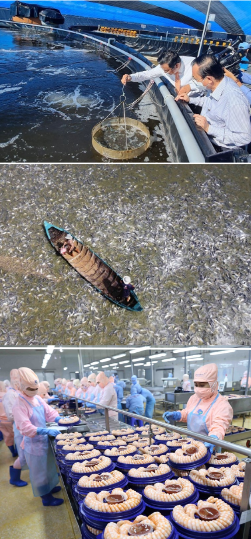
A high-tech shrimp farming model associated with environmental protection at the Bac Lieu high-tech agricultural park.
Tra/Basa/Panga fish farming in the Mekong Delta province of An Giang. The model is a collaborative effort between local farmers and businesses.
Vietnamese aquatic products have gained a firm foothold in international markets, and are now exported to 170 countries and territories. In the photo: The processing of shrimp by the Minh Phu Seafood Corp, destined for the US and Japanese markets.
The steel-hulled fishing vessel QNg 94359TS has a capacity of 811 CV. It was the first of its kind built with preferential loans from the Quang Ngai fishermen support fund to exploit seafood in the East Sea fishing grounds, in 2015.(left below)
Fish-raising cages in Gia Luan-Cat Ba Bay, which attract a host of visitors.(Top right)
Vietnam’s tuna export industry is navigating a turbulent start to the year. According to data from Vietnam Customs, export turnover in March 2026 reached nearly $80 million.
While this marks a sharp recovery from the $53 million recorded in February, it still represents an 11% decline compared to the same period in 2025.
For the first quarter of 2026, cumulative export value totaled $208 million, a 4% decrease year-over-year. Ms. Nguyen Ha, a Tuna Market Expert at VASEP, notes a significant divergence in global demand. Traditional powerhouses like the US and the EU continue to face economic headwinds, weighing down overall figures.
In contrast, several emerging markets have emerged as "bright spots," showing resilient growth despite the broader downward trend. These include:
Russia
The Middle East
Egypt
The Philippines
Mexico
Industry experts remain cautious as the sector balances these new growth opportunities against the ongoing pressures in major Western markets.
Bidding for scallops from Mutsu Bay was put on hold after the first auction of "semi-mature scallops," primarily used for processing, failed to find any buyers due to price disagreements.
Though the starting bid of 300 yen (about US$1.96) per kilogram was 85 yen (about US$0.55) lower than last year's record high, it was still deemed too high by dealers, who are currently struggling to sell off existing, high-priced inventory from the previous season. The auction featured 130 tons of the scallops.
This stalemate occurs amidst projections that scallop catches in Mutsu Bay are expected to plummet to around 10,000 tons this year, nearly half of last year's total. Despite this dramatic drop in supply, which usually leads to higher prices, the market resistance and inventory issues are complicating the start of the season. Fishery officials remain somewhat optimistic, suggesting that prices might stabilize after a few more rounds of bidding.
AKVA group and Laxey have officially entered into an agreement for the design and delivery of a second RAS smolt station in Vestmannaeyjar, Iceland.
The deal, celebrated by Laxey CEO Knut Nesse and COO Dadi Pálsson at the Seafood Expo Global in Barcelona, marks a significant expansion of their land-based salmon farming operations.
A Proven Collaboration
Building on a partnership that began in June 2022, the new facility (Smolt Station II) follows the success of the first station, which is now fully operational and has delivered five batches of high-quality smolt to date.
Scaling for the Future
The expansion will be executed in phases to ensure stable production and minimized risk:
Phase 1: Designed for an annual capacity of 5 million smolts (at 100g).
Phases 2 & 3: Future scaling targets of 10 million and ultimately 15 million smolts per year.
Construction is slated to begin in the summer of 2026, with operations expected to commence by Q4 2027. This milestone reinforces Laxey's commitment to responsible, large-scale land-based salmon production.
The domestic fishery sector has reported a resilient start to the year.
According to the latest data from Food World (Beijing), total aquatic product output across 20 provinces, autonomous regions, and municipalities reached 15.4711 million tons in the first quarter of 2026, marking a 4.30% year-on-year increase.
The growth was driven largely by the aquaculture sector. Marine aquaculture output rose to 4.491 million tons (up 5.63%), while freshwater aquaculture contributed a significant 8.5476 million tons (up 4.35%). Capture fisheries also saw modest gains, with marine fishing yielding 2.2565 million tons (1.77% increase) and freshwater fishing totaling 175,900 tons (1.29% increase).
Data was compiled from key regions including Beijing, Tianjin, Hebei, Liaoning, Jilin, Heilongjiang, Shanghai, Jiangsu, Zhejiang, Anhui, Fujian, Jiangxi, Shandong, Hubei, Hunan, Guangdong, Guangxi, Hainan, Chongqing, and Sichuan. These figures underscore a stable trajectory for the nation’s food security and maritime economy.
Viciunai Group, from Lithuania, and Frais Embal, from France, have won top prizes at the 2016 Seafood Excellence Global Awards at Seafood Expo Global, which is being held this week in Barcelona. The winners were selected from 35 finalists from 16 countries and were announced this Tuesday at a special Seafood Excellence Global Awards reception. The competition recognizes the best products exhibited at Seafood Expo Global.
The top prize for Best Retail Product was awarded to Viciunai Group for its Smoked Herring Flakes - Natural Flavor, a ready-to-eat herring product with a smoky, natural flavor and eye-catching packaging.
Source: iPac.aquacultura | Read the full article here
The Philippine government is exploring measures to stabilize domestic fish supply and support the nation’s fishing industry as high fuel prices have strained operations and raised concerns over the affordability of staple foods such as canned sardines.
Measures under consideration include raising fish import volumes if local fishing activity slows or stops due to mounting fuel costs, Philippine News Agency recently reported, citing Agriculture Secretary Francisco Tiu Laurel Jr.
Earlier this year, the country’s National Fisheries and Aquatic Resources Management Council authorized fish imports of 250,000 metric tons (MT) for 2026.
Author: Toan Dao / SeafoodSource | Read the full article here
The Argentinian shipyard has over 75 years of history and specializes in the construction and repair of fishing vessels. It has built and launched a total of 156 new vessels. All vessels are certified by RINA, Lloyds or Bureau Veritas.
Early ships were built of wood and the company later transitioned to construction in naval steel and marine-grade aluminium. Today the company has facilities capable of building up to 8 ships simultaneously under the roof of its 4 industrial buildings located in the port of Mar del Plata, Argentina.
There’s a message on the menu for diners eating at the Scottish pavilion at the Seafood Expo Global trade show in Barcelona this week.
A plate of tasty Scottish seafood products includes oysters for the first time since Brexit, signalling the resumption of the export of the shellfish to Europe.
The UK’s departure from the European Union led to a large increase in paperwork for exported shellfish, including the requirement for export health certificates and phyto-sanitary checks.
Source: fishfarmingexpert | Read the full article here
MOSCOW — China is set to solidify its position as the primary destination for Russian fish and seafood by 2025, according to a report from the newspaper Izvestia. While export volumes to the region are expected to dip 6% to 1.2 million tons, the total market value is projected to surge by 13%, reaching $3.4 billion.
The shifting landscape of Russian exports highlights a significant pivot toward Asian markets:
Japan: Ranks as the second-largest importer, with volumes hitting 118,000 tons (up 9%) and a valuation of $952 million (up 11%).
South Korea: Takes third place; despite a 3% volume decrease to 271,000 tons, the value grew 5% to $944 million.
Emerging Markets: Significant trade continues with the Netherlands, Belarus, Kazakhstan, and Nigeria.
Data from China’s General Administration of Customs confirms this momentum. Total Russian agricultural exports to China reached $7.98 billion in 2025, up from $7.34 billion in 2024. According to Ilyushin, director of the Russian Agricultural Export Development Center, the first quarter of this year already saw record-breaking figures, with exports hitting $2.4 billion—a massive 43% year-on-year increase.
Opmega arrives this Monday at Seafood Barcelona "with a completely renovated stand, larger than in previous editions and equipped with several meeting areas, ready to host the most comprehensive work agenda that the mussel producers' organization has ever deployed at the fair." This is according to the organization, chaired by Ricardo Herbón. The board of directors and sales managers of Opmega will hold meetings with operators and buyers from various countries, in what is expected to be "a particularly busy edition in terms of international business activity."
Source: La Voz de Galicia | Read the full article here
Opinion Article: Fishing in an Age of Barbarity Argentina
An Informe Técnico (Technical Report) is already circulating that violates the fishing law but seeks to justify the transfer of CITC (Individual Transferable Catch Quotas) from fresh-fish vesse...





 VIET NAM
 Vietnam’s fishery industry has overcome numerous challenges over the past 65 years to record remarkable progress and become a vital economic sector, making significant contributions to the stabilisation and growth of the national socio-economic landscape.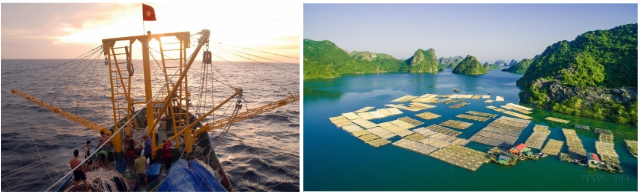
.png) While this marks a sharp recovery from the $53 million recorded in February, it still represents an 11% decline compared to the same period in 2025.
While this marks a sharp recovery from the $53 million recorded in February, it still represents an 11% decline compared to the same period in 2025. JAPAN
JAPAN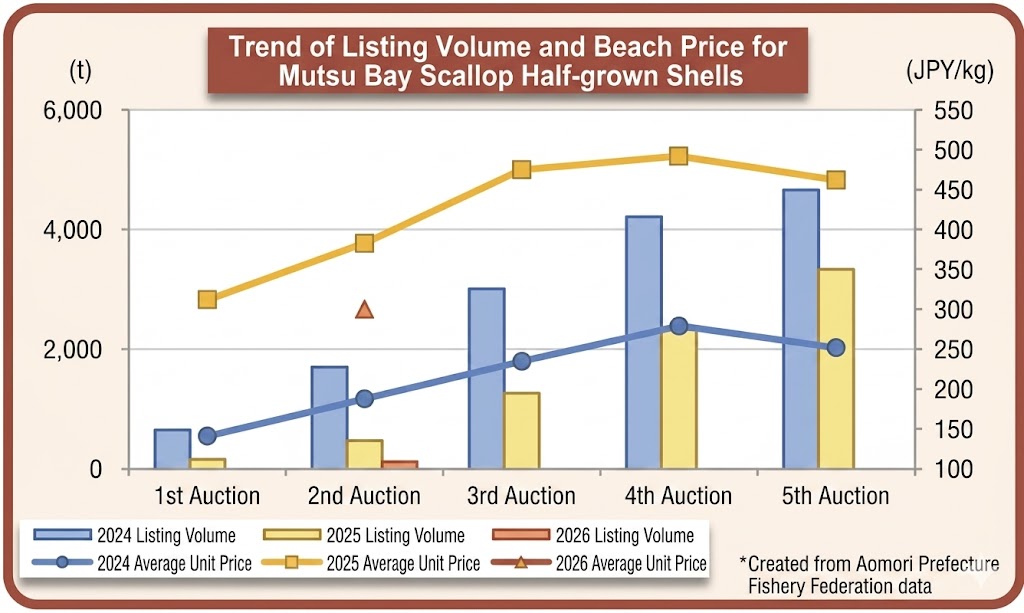
 SPAIN
SPAIN
 CHINA
CHINA_svg.png) According to the latest data from Food World (Beijing), total aquatic product output across 20 provinces, autonomous regions, and municipalities reached 15.4711 million tons in the first quarter of 2026, marking a 4.30% year-on-year increase.
According to the latest data from Food World (Beijing), total aquatic product output across 20 provinces, autonomous regions, and municipalities reached 15.4711 million tons in the first quarter of 2026, marking a 4.30% year-on-year increase. Viciunai Group
 PHILIPPINES
.png) The Philippine government is exploring measures to stabilize domestic fish supply and support the nation’s fishing industry as high fuel prices have strained operations and raised concerns over the affordability of staple foods such as canned sardines.
The Philippine government is exploring measures to stabilize domestic fish supply and support the nation’s fishing industry as high fuel prices have strained operations and raised concerns over the affordability of staple foods such as canned sardines. ICELAND
 Astillero Naval Federico Contessi y Cía. S.A
 There’s a message on the menu for diners eating at the Scottish pavilion at the
  RUSSIAN FEDERATION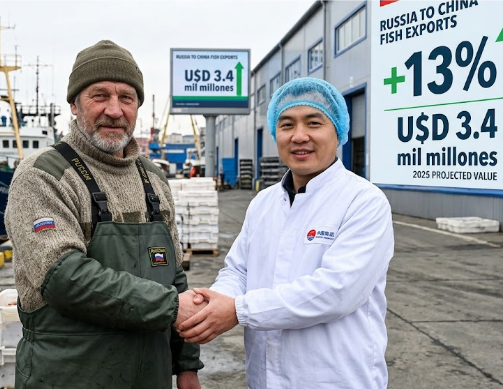
 Opmega