|
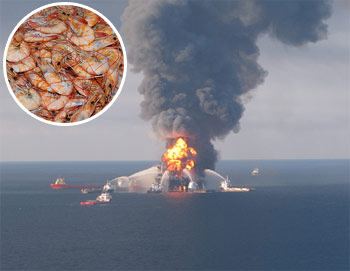
Authorities will make sure only oil-free seafood reaches consumers. (Photo: US Coast Guard/ FIS)
Gulf seafood allegedly safe to eat despite oil spill
 UNITED STATES
Thursday, April 29, 2010, 02:40 (GMT + 9)
Health and fishing industry experts assure seafood remains safe to eat despite the ongoing flow of 42,000 gallons of oil a day from a sunken rig off Louisiana’s coast.
"No one should be worrying about whether the shrimp they're having for dinner is going to have oil on it," said Mike Voisin, the past president of nonprofit organisation National Fisheries Institute (NFI).
If the oil moves inland, however, sea life and ecosystems in estuaries could be severely harmed.
 |
| Professor Chuck Wilson. (Photo: lsu.edu) |
"We're very concerned that east of the Mississippi River, based on currents and winds we're dealing with now, this oil will reach the shore," commented Chuck Wilson, Louisiana State University oceanography and coastal sciences professor, CNN reports.
Voisin said seafood will be safe to eat regardless.
"First, no company wants to put that kind of product on the market," he stated. "And those areas that have oil in them will be blocked by state health officials and not harvested."
Although 40 per cent of the seafood fished in the lower 48 states of the country originates from the Gulf of Mexico, 80 per cent of that consumed in the US is imported, he told.
Since last weekend, efforts to contain the spill that begun last week have failed; officials primarily blame disobliging winds.
If the oil spill isn’t restrained, species such as tuna and shrimp will instinctually voyage to oil-free waters, Voisin said.
The spill spans approximately 42 mi by 80 mi and is roughly 40 mi offshore, according to the US Coast Guard (USCG).
Voisin harvests oysters at his company in Houma, Louisiana. These animals are most at risk because they cannot move of their own volition and oil can get caught in their gills.
"[The oil] goes in marsh land and in the grass, that cannot just be cleaned and changed. You would have impacts probably for a year or two, or more," said John Tesvich, an oyster distributor and president of the Louisiana oyster dealers and growers association, wwltv.com reports.
Still, experts claim oysters’ shells protect their innards, such that an oyster with an oily sheen may still be consumed.
One tool that can confirm whether such an oyster is safe to eat is called a gas chromatographer. Health workers and harvesters regularly use them to measure traces of hydrocarbons in seafood, according to Dr Barbara Blakistone, NFI’s scientific affairs director.
"You can sample a section of water or, if you want to test each individual oyster, that's possible," she said. "But I think, perhaps in this case, they might have a pretty good idea how much oil they are dealing with."
BP, operator of the sunken rig, said it is launching submarine-like robots some 5,000 ft underwater to shut the rig's valves. The Coast Guard is also allowing BP to try to remotely activate a large valve at the top of the well to seal the leak.
Related article:
- Massive oil spill invades the Gulf Coast
By Natalia Real
[email protected]
www.seafood.media
|





 Print
Print