|
The adoption of these demanding transparency standards mitigates the risks of greenwashing before international regulators and global pension funds.
Mowi and the Green Bond Model in Large-Scale Aquaculture Under S&P Global Shades of Green Criteria)
 NORWAY
Thursday, June 11, 2026, 00:10 (GMT + 9)
Industrial aquaculture financing has undergone a profound structural transformation, migrating from traditional corporate credits toward labeled debt instruments with high climate demands.
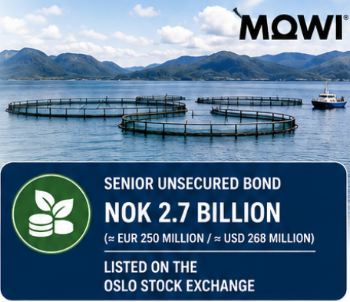
The recent placement of senior unsecured bonds worth NOK 2,700 million (equivalent to EUR 250 million or approximately US$ 268 million) by the multinational Mowi ASA on the Oslo Stock Exchange stands as the benchmark case study for understanding how leading companies in the seafood sector must structure their access to global capital.

Source: Mowi Sustainability Strategy
The Technical Debate: Why Green Debt and Not Blue?
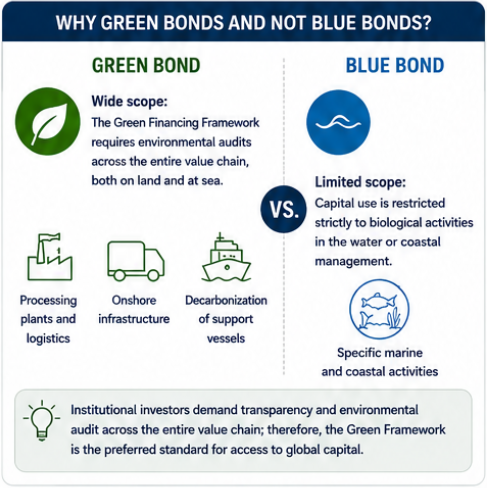
A recurring analytical question in the sector is why corporations operating natively in the marine environment opt for the issuance of green bonds (Green Bonds) instead of blue bonds (Blue Bonds), an instrument designed specifically for ocean preservation and a sustainable maritime economy.
The technical reason lies in the scope demanded by institutional investment funds. While a blue bond restricts the use of capital strictly to biological activity in the water or coastal management, the Green Financing Framework (Green Financing Framework) adopted by large companies requires environmental auditing across the entire terrestrial and marine value chain. This ranges from the energy efficiency of portioning and logistics plants to the decarbonization of support vessels at the docks.
S&P Global Shades of Green Evaluation Methodology
For a bond of this nature to be accepted in international capital markets, the corporation must submit its framework to an independent Second Party Opinion (Second Party Opinion - SPO). In the international market, the global benchmark entity for this analysis is S&P Global, which integrates and applies the original, rigorous scientific methodology of CICERO to assess how well an investment aligns with a low-carbon and climate-resilient future.
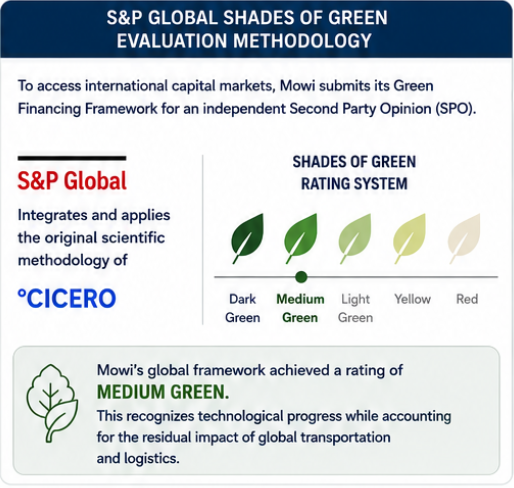
Under this rating system, called Shades of Green (Tonalities of Green), operations are evaluated against strict exclusion and compliance criteria:
-
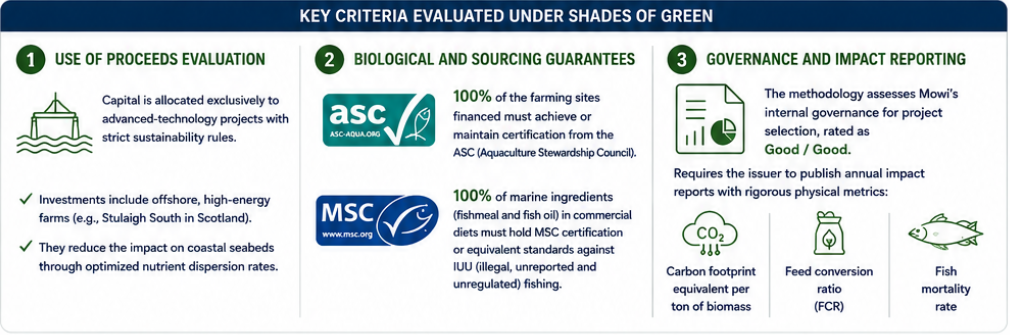
Assessment of the Use of Funds: The methodology ensures that capital is allocated to advanced technology projects with strict sustainability rules. In aquaculture, funds are directed exclusively to infrastructures such as high-energy offshore farms (for example, the new exposed Stulaigh South center in Scotland), which reduce the impact on coastal seabeds through an optimized nutrient dispersion rate. Mowi's global framework achieved a Medium Green (Medium Green) rating, recognizing the technological advancement but weighing the residual impact of global transportation and logistics.
-
Biological and Origin Guarantees: The audited framework imposes strict clauses where 100% of the farming centers benefiting from the financing must achieve or maintain certification from the ASC (Aquaculture Stewardship Council). Likewise, in the nutrition link, it requires that 100% of the marine ingredients (fishmeal and fish oil) in commercial diets possess MSC (Marine Stewardship Council) sustainability certification or equivalent standards against illegal, unreported, and unregulated (IUU) fishing.
-
Governance and Impact Reporting: The methodology rates the internal governance of the issuing company for project selection (achieving an official rank of Good / Buena). This obliges the producer to issue public annual impact reports detailing rigorous physical metrics, such as the carbon footprint equivalent per ton of biomass produced, the feed conversion ratio (FCR), and fish mortality rates.
Click on the image to enlarge it
The Impact on the Capital Market
The adoption of these demanding transparency standards mitigates the risks of greenwashing before international regulators and global pension funds. By structuring their debt under the official criteria of S&P Global Shades of Green, corporations manage to secure competitive interest rates and an oversubscription of demand in the order book, demonstrating that environmental sustainability is no longer a public relations policy, but a binding financial requirement to ensure commercial viability in the global Atlantic salmon (Salmo salar) market.
🇯🇵 日本語訳 (Japanese Translation)
S&P Global Shades of Greenの基準下における大規模養殖業でのモウィ社とグリーンボンドモデル
産業養殖業の資金調達は構造的な大転換を迎えており、従来のコーポレートローンから、高度な気候変動対策が要求されるラベル付き債券(環境債)へと移行しています。ノルウェーの多国籍養殖企業であるモウィ社(Mowi ASA)がオスロ証券取引所において、総額27億NOK(2億5,000万ユーロ、米ドル換算で約2億6,800万ドル)のシニア無担保債券を発行したことは、世界の水産セクターを牽引する企業がどのように国際資本へのアクセスを構築すべきかを示す最良のケーススタディとなっています。
技術的論争:なぜ「ブルーボンド」ではなく「グリーンボンド」なのか?
このセクターの分析において繰り返し浮上する疑問は、海洋環境を本拠とする企業が、なぜ海洋保全や持続可能な海洋経済に特化したブルーボンド(Blue Bonds)ではなく、グリーンボンド(Green Bonds)の枠組みを選択するのかという点です。
その技術的な理由は、機関投資家ファンドが求める監査対象の範囲にあります。ブルーボンドが資金の使途を水面下の生物学的活動や沿岸部での管理に厳しく限定するのに対し、大企業が採用するグリーン・ファイナンシング・フレームワーク(Green Financing Framework)は、陸上および海洋のバリューチェーン全体にわたる環境監査を義務付けています。これには、陸上での加工・物流工場のエネルギー効率から、港湾における支援船の脱炭素化までが含まれます。
S&P Global Shades of Greenによる評価手法
この種の債券が国際資本市場で承認されるためには、企業は自社の枠組みについて独立した第三者意見(セカンド・パーティ・オピニオン:SPO)を取得しなければなりません。国際市場においてこの分析の世界的指標となっているのがS&P Globalであり、同社は元CICEROの厳格な科学的評価手法を統合・適用して、投資が低炭素かつ気候変動に強い未来にいかに合致しているかを評価しています。
このShades of Green(グリーンの色調)と呼ばれる格付けシステムの下で、各事業は厳格な除外基準と遵守基準に基づいて評価されます。
-
資金使途の評価: 同手法では、資金が厳格なサステナビリティ規則を伴う高度な技術プロジェクトに配分されているかを監視します。養殖業において、資金はオープンオーシャン(外洋)型の高エネルギー養殖場(例:スコットランド西部のStulaigh South新設センター)などのインフラに限定して投入されます。これらの施設は、栄養塩の拡散率を最適化することで沿岸海への影響を軽減します。モウィ社の世界的枠組みは「Medium Green(ミディアム・グリーン)」の評価を獲得しました。これは技術的な進歩を認めつつも、グローバルな輸送や物流における残留炭素の影響を考慮した結果です。
-
生物学的および起源の保証: 監査された枠組みでは、資金調達の対象となるすべての養殖センターがASC(水産養殖管理協議会)の認証を取得、または維持しなければならないという厳格な条項が課されます。同様に、飼料(ニュートリション)の段階においても、商業用飼料に含まれる海洋由来原材料(魚粉および魚油)の100%が、持続可能性の証明であるMSC(海洋管理協議会)認証を取得していること、または違法・無報告・無規制(IUU)漁業に対抗する同等の基準を満たしていることを要求します。
-
ガバナンスとインパクト報告: 同手法では、プロジェクト選定における発行体の社内ガバナンスを評価し、公式に「Good(優良)」のランクを付与しています。これにより、生産者は毎年、生産されたバイオマス1トンあたりの二酸化炭素換算排出量、増肉係数(FCR)、魚の死亡率などの厳格な物理的指標を詳細に記したインパクトレポートを公表することが義務付けられます。
資本市場への影響
これらの厳しい透明性基準の導入は、国際的な規制当局や世界の年金基金に対するグリーンウォッシングのリスクを排除します。S&P Global Shades of Greenの公式基準の下で債券を構造化することにより、企業は競争力のある金利を確保し、ブックビルディング(需要予測)において募集額を大幅に上回る需要を集めることに成功しています。これは、環境サステナビリティがもはや単なる広報活動(PR)ではなく、タイセイヨウサケ(Salmo salar)のグローバル市場において商業的生存権を確保するための、拘束力のある財務要件であることを証明しています。
🇨🇳 简体中文译文 (Simplified Chinese Translation)
S&P Global Shades of Green 基準下的大型养殖业莫威公司与绿色债券模式
工业化 aquaculture 养殖业的融资正在经历深刻的结构性转变,正从传统的企业贷款转向具有高度气候要求的贴标债务工具(环境债券)。挪威多国籍养殖巨头莫威公司(Mowi ASA)在奥斯陆证券交易所成功发行总额达27亿挪威克朗(折合2.5亿欧元,约合2.68亿美元)的高级无担保债券,成为全球鱼类及海鲜领域领军企业如何构建国际资本渠道的基准案例。
技术争鸣:为何选择绿色债务而非蓝色债务?
该行业分析中反复出现的一个疑问是,为何母体业务原生于海洋环境的企业,会选择发行绿色债券(Green Bonds)框架,而非专门用于海洋保护和可持续海洋经济的蓝色债券(Blue Bonds)。
其技术原因在于机构投资基金所要求的审计覆盖范围。蓝色债券将资金用途严格限制在水下的生物学活动或沿岸管理上,而大型企业所采用的绿色融资框架(Green Financing Framework)则强制要求对整个陆地及海洋价值链进行全方位的环境审计。这涵盖了从陆地加工与物流工厂的能源效率,到港口支持船只的脱碳化。
S&P Global Shades of Green 的评估方法学
此类债券若要在国际资本市场上获得认可,企业必须将其框架提交给独立的第二方意见(Second Party Opinion - SPO)机构进行评估。在国际市场上,该项分析的全球行业基准是 S&P Global(标普全球)。该公司整合并应用了原 CICERO 严格的科学评估方法,以评估投资项目与低碳及气候具弹性未来的契合程度。
在这种被称为 Shades of Green(绿色调)的评级系统下,各项业务均基于严格的排除标准和合规标准进行评估:
-
资金用途评估: 该方法学严密监控资金是否投向伴随严格可持续性规则的高新技术项目。在养殖业中,资金被定向用于外海(深海)型高能量养殖场(例如苏格兰西部新设的 Stulaigh South 养殖中心)等基础设施。这些设施通过优化营养盐扩散率,减轻对沿岸海床的影响。莫威公司的全球框架获得了“Medium Green(中绿)”评级,这既肯定了其技术进步,同时也考量了全球运输和物流中残留碳足迹的影响。
-
生物学及源头保证: 受审框架施加了严格条款,规定受益于该融资的100%的养殖中心必须获得或保持ASC(水产养殖管理委员会)认证。同样,在饲料(营养)环节,要求商业饲料中所包含的海洋来源原材料(鱼粉和鱼油)的100%必须拥有可持续性证明的MSC(海洋管理委员会)认证,或符合打击非法、不报告和管制(IUU)捕捞的同等标准。
-
治理与效益报告: 该方法学对发行体在项目筛选方面的内部治理进行评级(官方评定为 Good / 优秀 等级)。这迫使生产商必须每年发布公开的效益报告,详细列出严格的物理指标,例如每吨产量所对应的二氧化碳当量排放量、饲料转化率(FCR)以及鱼类的死亡率。
对资本市场的影响
采用这些严苛的透明度标准,消除了国际监管机构和全球养老基金对“洗绿(greenwashing)”风险的担忧。通过在 S&P Global Shades of Green 的官方标准下构建债务,企业成功确保了具竞争力的利率,并在簿记建档中吸引了大幅超额的认购需求。这有力地证明了,环境可持续性已不再是单纯 axial 的公关(PR)政策,而是确保在大西洋鲑(Salmo salar)全球市场中具备商业生存能力的约束性财务硬性要求。
[email protected]
www.seafood.media
|




.png)
 Print
Print