|
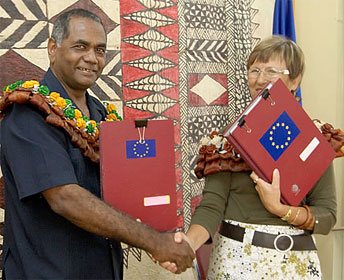
Increasing Agricultural Commodity Trade signing EU-SPC Agreement. (Photo: SPC.int)
EU helps Pacific countries develop global role
 NEW CALEDONIA NEW CALEDONIA
Wednesday, June 01, 2011, 15:20 (GMT + 9)
The European Union (EU) and the Secretariat of the Pacific Community (SPC) have inked a Contribution Agreement for a project aiming to boost Pacific African, Caribbean and Pacific Group of States (ACP) countries’ ability to benefit from global trade and regional economic integration.
The project, Increasing Agricultural Commodity Trade (IACT), is funded by the 10th European Development Fund (EDF) and falls under the EUR 30 million EU programme, Strengthening Economic Integration Through Trade (SPEITT). SPC will be the implementing agency for IACT.
IACT will start mid-year. It is a four-year project that will be implemented by SPC through its Land Resources and Fisheries, Aquaculture and Marine Ecosystems Divisions.
Ritva Sallmén, Chargée d'Affaires ai of the Delegation of the EU for the Pacific, noted that Pacific ACP countries are hindered by challenges that limit their ability to participate and profit from the global economic market despite the potential of, for example, their aquaculture sectors.
“The IACT project will work with the private sector and government agencies to address these and other constraints to trade, thereby contributing to the goal of greater economic integration in the Pacific region,” she stated.
SPC Director-General Dr Jimmie Rodgers commented that, thanks to the EU’s funding of IACT, Pacific Island countries and territories will now be able to collaborate to sustainably expand exports and achieve long-term change in their rural communities.
The IACT project will operate in the 15 Pacific ACP members: Cook Islands, Federated States of Micronesia, Fiji Islands, Kiribati, Nauru, Niue, Palau, Papua New Guinea, Marshall Islands, Samoa, Solomon Islands, Timor Leste, Tonga, Tuvalu and Vanuatu.
IACT’s main goal is to improve these countries’ economic integration through fortified national systems and institutional frameworks, develop trade capacity, advance private sector competitiveness and amplify international market access.
Specifics include -
- Strengthening and diversifying the range of tradable products produced by private sector operators in Pacific ACP countries;
- Reinforcing the technical capacity of Pacific ACP governments, intermediary organisations and the private sector to swell market access and penetration for niche and value-added products;
- Boosting capacities of Pacific ACP national departments and export enterprises in the targeted sectors to meet international trade standards;
The EU has allocated EUR 95 million for the Pacific region under the 10th EDF Regional Indicative Programme: EUR 45 million for regional economic integration (including the SPEITT programme), EUR 40 million for sustainable management of natural resources and the environment and EUR 10 million for non-state actors & technical cooperation.
Related article:
- Pacific ACP countries seek extension to global sourcing rules
By Natalia Real
[email protected]
www.seafood.media
Photo Courtesy of FIS Member  SPC - Secretariat of the Pacific Community (Headquarters) SPC - Secretariat of the Pacific Community (Headquarters)
|



 Print
Print