|
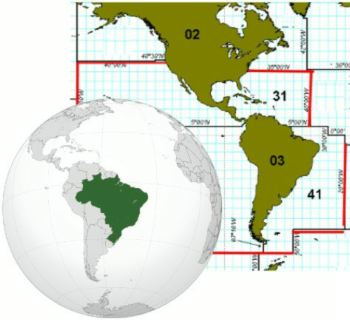
Brazil and FAO 41
ILLEGAL FISHING AND MIGRATORY RESOURCES. ANALYSIS OF BRAZIL'S FISHERIES LAW
 BRAZIL
Sunday, October 09, 2022, 17:00 (GMT + 9)
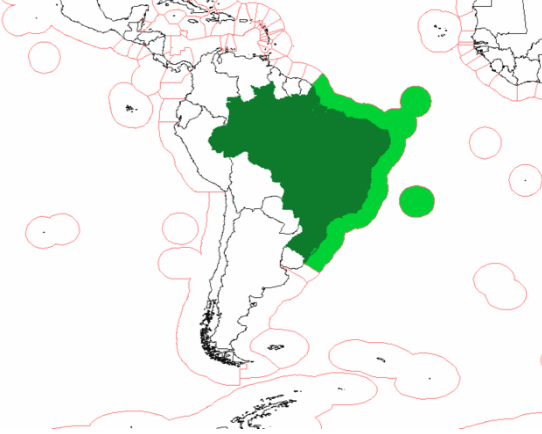
Brazil EEZ.Source: Wikipedia
The Fisheries Law of the Federative Republic of Brazil was sanctioned by Law 11,959 of June 29, 2009 and Regulatory Decree 4,810 of August 19, 2003.
It establishes the national policy for the sustainable development of Aquaculture and Fisheries. regulating fishing activities and, in Article 1o I of the Law, it prescribes "sustainable development as a source of food, income and leisure, guaranteeing the sustainable use of fishing resources, as well as the optimization of the resulting economic benefits, in harmony with the preservation and conservation of the environment and biodiversity" and, article 5 that the exercise of the activity must guarantee (I) "the protection of ecosystems and the maintenance of the ecological balance, in accordance with the principles of preservation of biodiversity and sustainable use of natural resources" and it is already evident in these first articles, the vocation of Brazil to preserve its resources for the enjoyment of current and future generations.
In article 6, paragraph 2, agreeing with the sustainability of the resource in the extraction and/or capture stage, "prohibits the transport, commercialization, transformation and industrialization of specimens from prohibited fishing activities", that is, ILLEGAL FISHING , among other prohibited practices.
.jpg)
Source: Instituto Igarapé:The Blue Amazon: Brazil Asserts Its Influence Across the ...
In article 12, paragraph 1, it indicates that transshipment is authorized "regardless of the authorization, in the event of an accident or mechanical defect that entails the risk of losing the product of the fishery or its derivative", which is indicating that normal transshipments They must be carried out in port and in an authorized manner, a very important matter, since it is known that, through these, ILLEGAL FISHING is usually "laundered".
With regard to fishing control, article 32 establishes that "the competent authority may determine the use of a flight map and a satellite tracking device, as well as any other device or procedure that allows remote monitoring and automatically controls and, in real time, the geographical position and the depth of the vessel's fishing spot…”, apart from the fact that article 35 establishes the obligation to keep on board, without load for said authority, lodging and food for ( I) «an observer on board, who will collect data, research material and information of interest to the fishing sector, as well as environmental monitoring». By the way, it must be understood that the observer is an independent agent or a State official.
.jpg)
A sleeping giant: the historically neglected Brazilian fishing sector. Authors: José Belquior GonçalvesNeto, Felipe Augusto de Alencar Goyanna, Caroline Vieira Feitosa and Marcelo Oliveira Soaresa
Regarding Decree 4,810 regulating the Brazilian Fisheries Law, we will analyze some of its articles of interest. In article 1, paragraphs 1 II (continental shelf) and 1 III (EEZ) it is allowed, according to paragraph 3, operations of foreign vessels leased through international agreements signed by Brazil in accordance with paragraph 5, under the conditions and limits established in the agreement, without prejudice to compliance with Brazilian law. In other words, even accepting fishing exploitation in the EEZ by means of foreign leased vessels, Brazil maintains its territorial sovereignty through bilateral agreements without appealing to the intervention of RFMOs.
In the 2nd article we find a ratification of what we maintain: “fishing species are not an intrinsic part of the sea, but rather live in it”. And this article refers to it, in this way: "... the capture, transformation or investigation of animal beings (...) that have their natural or most frequent environment of life in the waters" and, this, is very important when it comes to discuss the ownership of the species that, being native to the EEZs and the domain of the coastal States, migrate to the high seas in their biological cycle to later return to the EEZs.
In Article 3, when referring to "highly migratory species and those that are underexploited or unexploited, it will correspond to the Special Secretariat of Aquaculture and Fisheries (...) to authorize and establish measures that allow the adequate, rational and convenient use of these fishing resources »; understanding the special protection that must be carried out when species are migratory to ensure sustainability. Within these measures, it should be specified that they could reach fishing agreements with flag States on the high seas to give sustainability to the ecosystem and optimize Brazil's catches, in accordance with what Article 4 establishes.
.png)
Major marine coastal ecosystems of Brazil.(Source: Antonio Carlos Diegues, Marcelo Vasconcellos and Daniela Coswig Kalikoski)
It is interesting to note that the leasing of foreign vessels has in its 4th article a series of objectives that should be fulfilled, among them, the one indicated in point IV: "foster the formation of a national fleet capable of operating in deep waters" and, in VII: "Sustainable use of fishing resources in international waters", which which demonstrates Brazil's interest in exploiting the resource in high sea and do it sustainably. In this regard, it could be interesting that Brazil, Argentina and Uruguay look for associative formulas, as coastal States of the Southwest Atlantic, to jointly control and eventually reach Agreements for the exploitation of their migratory resources on the high seas.
Article 9 IV establishes the obligation to “maintain on board the ship, without cargo for the Union, accommodation and food to serve the Brazilian technician or observer on board”; in section V "carry out fishing operations in order to guarantee the sustainable use of living marine resources in fishing areas" and section VI "Use equipment that allows tracking or satellite monitoring", all issues aimed at controlling fishing operations and prevent ILLEGAL FISHING. On the other hand, in VIII 5 it indicates that failure to comply with the obligations "will imply the seizure of the vessel by the Maritime Authority...", that is, without paying attention to the UNCLOS rules that prevent the confiscation of vessels that have been practicing ILLEGAL FISHING; question that we understand positive as a tool to combat this scourge.
.png)
A small boat crew from the USCGC Stone (WMSL 758) drives alongside the Brazilian navy ship Guaiba off the coast of Northern Brazil on Jan. 4, 2021. The Stone and the Guaiba partnered together to share and practice law enforcement and rescue tactics as part of Operation Southern Cross. (Photo: U.S. Coast Guard Petty Officer 3rd Class John Hightower)
On the other hand, Article 12 indicates that the leased foreign fishing vessel may only transship the fishery product to the port infrastructure and to the national fishing terminals or in their respective port areas, that is to say that transshipment at sea is prevented and, that non-compliance (paragraph 1) may lead to the seizure of the vessel and IBAMA request support (paragraph 2) from other public agencies in the repression of crime.
Likewise, by application of Article 16, “the commanders of Brazilian fishing vessels and those of the national merchant fleet, when they detect foreign vessels carrying out fishing activities in Brazilian areas, shall notify the Maritime Authority, for due and immediate measures, the date, time and geographical position of the vessels, at the time of occurrence, also indicating name and nationality” and, this practice should be systematic and agreed so that all national fishing vessels serve to control ILLEGAL FISHING by foreign vessels, establishing a Manual of Procedures in this regard, including giving participation of the fines to those denounced.
We could finally say that the Brazilian Fisheries Law, although it has a precise orientation regarding the fight against ILLEGAL FISHING, should improve its instruments to ensure that some of the issues that have been adequately announced are passed into action, in favor of the eradication of this scourge that prevents the coastal States from obtaining all the essential protein resources, guaranteeing in perpetuity the sustainability of the species and the ecosystem.
.jpg)
Dr. Cesar Augusto Lerena
South Atlantic and Fisheries Expert – Former Secretary of State
President of the Agustina Lerena Foundation1
President Center for Studies on Latin American Fisheries (CESPEL)2.
Author of "Illegal Fishing and Migratory Fishing Resources Originating from the Coastal States of Latin America and the Caribbean" (2022)
(1) Founded on 10/21/2002; (2) Founded on 2/4/1989
September 2022 (ISBN 978-987-29323-9-8)
Related news:
.jpg)
.jpg)
.jpg)
.jpg)
.jpg)
[email protected]
www.seafood.media
|





 Print
Print