|
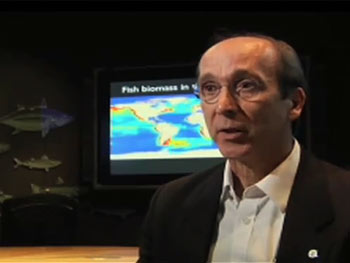
Professor Villy Christensen of the UBC Fisheries Centre. (Photo: YouTube/wwwAAASorg)
Overfishing of big species leaves more small fish in the sea: study
 CANADA
Tuesday, February 22, 2011, 02:40 (GMT + 9)
Predatory fish stocks have dwindled by two-thirds while small forage populations have grown by over 100 per cent fish over the past century as a result of overfishing. Some of the species involved are cod, tuna and groupers and sardine, anchovy and capelin, said researchers from the University of British Columbia (UBC).
Professor Villy Christensen of UBC’s Fisheries Centre has led a team of scientists who applied more than 200 marine ecosystem models from around the world for their work, to come up with more than 68,000 estimates of fish biomass dated from 1880-2007. They just presented their conclusions at the American Association for the Advancement of Science (AAAS) Annual Meeting in Washington, DC.
This study’s findings of the concurrent decline of predatory fish and climb of forage fish is thus far the strongest evidence that humans are “fishing down the food web” and having an effect on global ecosystems. As well, the team found that a staggering 54 per cent of the decline in predatory fish stocks occurred in the last 40 years alone.
“Overfishing has absolutely had a ‘when cats are away, the mice will play’ effect on our oceans,” said Christensen, a professor in the UBC Fisheries Centre. “By removing the large, predatory species from the ocean, small forage fish have been left to thrive.”
">
Christensen warned that even though the doubling of forage fish means more fish production, the lower trophic-level food web is more susceptible to environmental changes.
“Currently, forage fish are turned into fishmeal and fish oil and used as feeds for the aquaculture industry, which is in turn becoming increasingly reliant on this feed source,” said Christensen. “If the fishing-down-the-food-web trend continues, our oceans may one day become a ‘farm’ to produce feeds for the aquaculture industry. Goodbye, wild ocean!”
As well, the scientist noted that the fluctuations in stocks could lead to greater disease among fish, reports Vancouver Sun.
"Take the Serengeti, for example. What would happen there if we removed all the predators -no lions or leopards? The antelopes and other plant eaters would grow in number and there would be no one to remove the sick, old and injured animals, and that could lead to widespread problems with diseases," Christensen noted.
The professor’s presentation was part of an experts’ panel to address the question “2050: Will there be fish in the ocean?” The panel predicted that most of the fish left in 2050 will be of the smaller variety.
Related articles:
- No more room to expand fisheries: study
- Pacific fisheries face collapse by 2035: study
By Natalia Real
[email protected]
www.seafood.media
|





 Print
Print