|
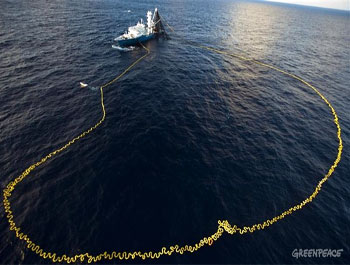
Fishing vessels will be supervised through radio transponders to make sure the agreed catch limits are enforced. (Photo: Paul Hilton/Greenpeace)
WCPFC meeting leads to cuts in bluefin tuna fishing for 2011-12
 UNITED STATES
Tuesday, December 14, 2010, 03:40 (GMT + 9)
Twenty-five member countries of the Western and Central Pacific Fisheries Commission (WCPFC) recently met in Honolulu, Hawaii, and agreed to fish for bluefin tuna in the central and western Pacific in amounts not greater than the average back in 2002-4. The countries have made the agreement to curtail their tuna catch in sections of the Pacific Ocean to save the stock from depletion.
 |
| Greenpeace activists hang a banner from Honolulu's Aloha Tower the day before the 2010 WCPFC meeting begins urging tuna conservation.(Photo: Greenpeace) |
The deal will go into effect in 2011 and 2012. It will establish the planet’s biggest marine reserve in the Pacific Ocean region to be known as the Eastern High Seas; the area, which spans 1.2 million sqmi, is about the size of India.
According to fisheries scientists, the current bluefin tuna stock has diminished from 1.2 million tons in 1952 to half a million tonnes today due to the use of mechanised purse-seine nets that catch entire schools of fish in one go, AHN News reports.
Fishing vessels will be supervised through radio transponders to make sure the agreed catch limit in the Eastern High Seas is enforced.
This comprises the first international agreement on cuts in the catch of this species in the Pacific and comes after measures made to limit catch limits in the Atlantic Ocean, reports Australia Network News.
Japan will have to lessen its yearly catches of bluefin tuna aged less than three years by about 25 per cent from the current level of 6,100 tonnes.
Even though South Korea refused to sign the agreement, officials said the country will also curb its catch of young bluefin.
Fishing boats from both countries have been harvesting big quantities of young bluefin tuna in the Pacific Ocean with large net fishing vessels, which critics argue jeopardises bluefin tuna stocks.
At the same time, the WCPFC did not establish further agreements to thwart the overfishing of many key species, Radio New Zealand International reports.
A group of Pacific nations known as the Parties to the Nauru Agreement (PNA) - the Federated States of Micronesia, Kiribati, Marshall Islands, Nauru, Palau, Papua New Guinea, Solomon Islands and Tuvalu - had gone to the meeting wanting to stiffen measures to close the high seas fishing areas between the individual countries’ exclusive economic zones (EEZ).
As well, there had been intentions to lower the level of fishing for bigeye tuna.
">
Additionally, the meeting rebuffed a proposal to prohibit placing nets on schools that congregate near whales, dolphins and whale sharks.
Greenpeace New Zealand Oceans Campaigner Karli Thomas called the meeting’s result an insult to Pacific Island marine protection efforts.
">
“For the Pacific region’s people, no fish means no future. Governments at this meeting had a responsibility to stop foreign fleets from taking food from the plates of the Pacific people by agreeing measures to protect the region’s food security and economy, not just the profits of the industrial fishing industry, “ she stated.
Related articles:
- Bigeye tuna focus at this year's WCPFC conference
- PNA extends tuna fishing ban
- Japan, Marshall Islands’ negotiations reach impasse
By Natalia Real
[email protected]
www.seafood.media
|





 Print
Print