|
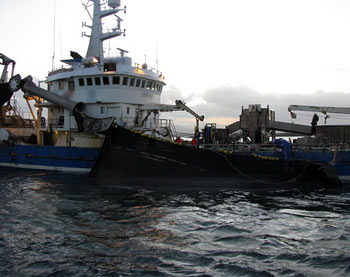
Mackerel purse seiner. (Photo: bjarniolafssonak.123.is/blog)
Faroese justify quota increase
 FAROE ISLANDS
Tuesday, August 31, 2010, 21:50 (GMT + 9)
The Faroese have said that evidence of a remarkable shift toward the northwest in the migratory mackerel population suggests that increasing their mackerel quota from 35,000 to 85,000 tonnes is justified.
Consultations between the mackerel Coastal States fell short of reaching a multilateral agreement for this year with the EU and Norway agreeing on a quota between themselves that leaves nothing to the Faroese or the Icelanders, claims the Faroese Pelagic Organisation (FPO).
Therefore the FPO say that the present agreement made between the EU and Norway raises questions of credibility as it allots the two parties as much as 110 per cent of the total allowable catch (TAC) of 570,000 tonnes recommended by the International Council for the Exploration of the Sea (ICES).
“The move by the EU and Norway to first take more than everything for themselves and then blame others for irresponsibility is hardly a testimony to their commitment to responsible management,” said managing director Jógvan Jespersen of the FPO.
Jespersen argued that left out of the agreement, the Faroese could only set their own quota.
“We are very disappointed over the decision by the pelagic industry in the EU and Norway to block Faroese vessels from landing mackerel and thereby to terminate their decade-long cooperation with our fleet,” Jespersen said.
He underlined that all Coastal States parties have a shared responsibility to sort out the differences that sank this year’s mackerel agreement.
“Indeed the blame pointed at the Faroese is based on the perceived possibility that the future health of the mackerel stock could be in jeopardy given the absence of a comprehensive agreement among the Coastal States. Be that as it may, the EU and Norway certainly must take their share of the responsibility for any failure to restore the multilateral agreement. The Faroese made every effort to reach a negotiated solution and were willing to compromise if necessary.”
According to Jespersen, there were two major disagreements at the Coastal States mackerel negotiations for 2010 in Clonakilty last October and in Edinburgh last November.
“First, it turned out that the mackerel had left Norwegian waters earlier than expected, and so the Norwegians were upset at the EU’s refusal to give Norwegian vessels access into EU waters for catching the remaining 70,000 tonnes of their quota. Second, the Faroe Islands demanded a change to the sharing of the quota to reflect the changed geographical distribution of the mackerel stock.”
The arguments presented by the Faroese are based on a new consensus between scientists and fishermen that the juvenile and adult mackerel population has moved increasingly toward the northwest, which means the mackerel is found in Faroese waters to a larger degree than ever and over a longer period of the year.
The Faroese argue that the officially recognised scientific data regarding the size of the mackerel stock are based on inadequate methodologies and extremely conservative recommendations on catch, with egg surveys only recently taking place in the now densely populated waters around Iceland and the Faroe Islands.
“What’s obvious to everyone here is that the mackerel is booming and the waters are brimming with it.”
Related articles:
- EU overfishing charges 'preposterous'
- Brusels warns Iceland, Faroes over 'mackerel war'
- Mackerel wars not sustainable: WWF
By Michael Loubet
[email protected]
www.seafood.media
|




 Print
Print