|
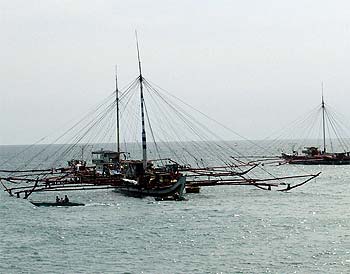
Philippine tuna fishing vessels. (Photo: FB-Archive)
Tuna industry pushes for more fishing grounds
 PHILIPPINES
Tuesday, June 22, 2010, 00:40 (GMT + 9)
The Philippines’s tuna industry is requesting that the national government arrange bilateral fishing access agreements with other tuna-abundant countries to counterbalance the industry’s slowed production due to the fishing ban in areas of the Pacific Ocean.
Bayani B Fredeluces, executive director of the Socsargen Federation of Fishing and Allied Industries, said the ban imposed by the Western and Central Pacific Fisheries Commission (WCPFC) – which is being backed and enforced by the government – is adversely impacting the operations of tuna fishing companies.
"The government, through the Bureau of Fisheries and Aquatic Resources (BFAR), should make concrete moves now to help our purse seine operators in the wake of the ban [that will last for two years]," Fredeluces stated, Business World reports.
The local fishing federation wants the national government -- soon to be taken over by President-elect Benigno Simeon C Aquino III — to work out fishing access agreements with Palau and other Pacific Island nations, so local purse seine operators can work in the islands’ territorial waters, he told. The ban has been going on for almost seven months now.
Local fishing companies can fish in Indonesia and Papua New Guinea’s waters if they have onshore investments in those countries, as is the case of the home-based RD Corp.
In December 2008, WCPFC approved the closure in Busan, South Korea, in a document called "Conservation and Management Measure for bigeye and yellowfin tuna in the Western and Central Pacific Ocean."
The closure for purse seine fishing took effect on 1 January 2010 and runs through 2012. It spans two pockets of the high seas in the western and eastern parts of the Pacific Ocean.
Pocket 1 covers Palau, Micronesia, Papua New Guinea and Indonesia. Fredeluces noted these are closest to the Philippines and where local tuna fishers often work.
Pocket 2 is represents the Solomon Islands, Fiji, Tuvalu, Nauru, Marshall Islands, Micronesia, Papua New Guinea and parts of Kiribati.
The high seas surrounding Cook Islands, French Polynesia and parts of Kiribati are not covered by the ban.
Fredeluces has said that an initial study by the local fishing federation forecasted that, due to the ban, tuna catch from purse seine fishing would fall by 10-20 per cent.
A study by the University of the Philippines-Visayas’ College of Fisheries and Ocean Science showed there is a need for the local tuna industry to seek alternative fishing areas. One involves still-untested areas of the Philippines’ exclusive economic zone (EEZ), although the study warned these waters may not be as profitable as the closed fishing areas in the Pacific.
The regional office of the Department of Labor and Employment said the ban will affect 1,600 workers.
The value of the Philippines’ tuna exports dropped by a fifth last year versus 2008 partly resulting from a ban on fish aggregating devices (FADs) in the Pacific Ocean. WCPFC pushed the ban on in August to September in an effort to conserve yellowfin and bigeye tuna stocks.
Related articles:
- Tuna exports take a dive
- Tuna companies prepare for fishing bans
By Natalia Real
[email protected]
www.seafood.media
|





 Print
Print