|
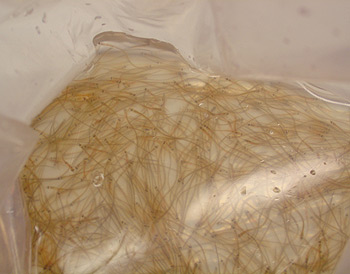
Baby glass eel. Japanese scientists have made a breakthrough in second-generation eel farming. (Photo: Akihito)
Eel farming unprecedently accomplished
 JAPAN
JAPAN
Thursday, April 22, 2010, 00:00 (GMT + 9)
The Fisheries Agency announced this month its globally unprecedented success in complete second-generation eel farming by using sperm and eggs collected from those artificially raised from eggs. It will take time before the method is put into practical use, however.
The achievement by the Fisheries Research Agency in Yokohama, Kanagawa Prefecture, may allow Japan to secure declining eel resources: last season’s national catch of glass eels has been decimated this year as of late February, the agency informed on Monday.
Fisheries experts say overfishing may be the reason for the 90 per cent drop in catch levels and fear elvers may thus soon be placed under a trade ban under the Washington Convention.
Juvenile Japanese eel season runs from December-April, when the fish have migrated to the waters off Japan before swimming upriver, The Yomiuri Shimbun reports.
Some 65,000 tonnes, or 99 per cent, of the eels consumed in Japan are farmed. Two-thirds of these are imported from China and other countries and one-third are farmed on the islands.
Glass eels need at least six months until they are mature enough to be sold, such that farmers must pen them by late January to ship them by the celebration of the Day of the Ox in July, when eating eel is believed to grant auspicious health.
The current farming system is based on the gathering of juvenile eels; the Yokohama centre, however, managed to artificially breed eel larvae in 2002 for the first time in the world.
In the new procedure developed by the Fisheries Agency, glass eels that are 45-70 cm long are given hormones to stimulate sexual maturation for sperm and eggs extraction. On 26 March, the Agency extracted some 250,000 fertile eggs through artificial insemination.
Some hatched on the following day and are now growing steadily, the organisation informed, reports Mainichi Japan.
Thus far this year, one eel wholesaler said, wholesale prices of domestically farmed eels sold to broiled eel restaurants have jumped to JPY 570 (USD 6.13) per eel from JPY 520 (USD 5.59) in autumn. Farmed Chinese eels have gone from some JPY 470 (USD 5.06) to around JPY 520 (USD 5.59).
Unlike those experts blaming this season’s low eel catch on overfishing, Shingo Kimura, marine ecologist and professor at the University of Tokyo's Atmosphere and Ocean Research Institute, blames El Niño.
"Due to the effects of last year's El Niño, sea currents have changed course and glass eels might be unable to reach the waters around Japan," he explained.
Numbers have been dropping since the early 1960s, when some 200 tonnes of elvers were hauled per season. In contrast, recent years have seen catch volumes of 10 tonnes.
Related article:
- Record haul of smuggled Chinese eels nabbed
By Natalia Real
[email protected]
www.seafood.media
|





 Print
Print