|
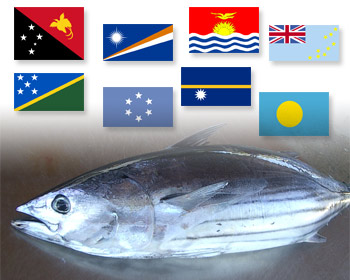
The new cartel set up by the eight Pacific Nations will be loosely based on OPEC. (Photo: FIS)
8 Pacific nations establish tuna cartel
 PALAU PALAU
Thursday, February 25, 2010, 21:30 (GMT + 9)
Leaders from eight Pacific Island nations whose waters provide a quarter of the world's tuna announced plans Thursday to form a regional tuna cartel to increase their share of the profits from the lucrative fish.
The initiative — by the mostly poor nations with little land but controlling a stretch of equatorial ocean one and a half times the size of the United States — is intended to increase their share of the USD 2 billion generated annually from tuna caught in their waters.
More than 85 per cent of the revenues currently go to fishing companies and others based in the US, Japan, Taiwan and other Asian countries.
 |
| Palau President Johnson Toribiong. (Photo: doi.gov) |
"The time has come for us to assert our right to claim our rightful, fair and equitable share from the harvesting of tuna stocks in the fishing grounds under our jurisdiction," said Johnson Toribiong, president of Palau and host of the one-day meeting of regional leaders on tuna in the capital, Koror, AP reports.
The Pacific leaders said they would increase fishing fees by requiring purse seine vessels — which function as huge tuna shovels by using nets to catch the lion's share of fish in the ocean — to bid against each other for the right to fish in their waters.
Kiribati President Anote Tong said that, taken together, the measures signal the start of something significant.
"This is a very serious attempt of conserving the resource at the same time as getting as much of a return as possible for the resource owners," Tong said. "We haven't been getting our fair share."
Cartel signatories — Papua New Guinea, the Marshall Islands, Kiribati, Solomon Islands, Tuvalu, the Federated States of Micronesia, Nauru and Palau — say increased controls will also help sustain the world's major resource of abundant tuna.
In 2008, more than 2 billion pounds (1 billion kilos) weight of tuna was removed from the eight countries' waters.
Scientists say that skipjack tuna, which is typically canned, remains plentiful in the region. But stocks of yellowfin tuna are being fished at near capacity while bigeye tuna, prized in Japan for its oily flesh, is being overfished.
In a collective muscle flexing, the eight countries also agreed Thursday to effectively ban fishing from 1.8 million square miles (4.5 million square kilometers) of the equatorial Pacific — an area half the size of the United States — by demanding that foreign purse seine fishing boats in their territories stay out of these otherwise open areas of ocean.
In the weeks leading up to Thursday's declaration, the eight nations, bound since 1982 by a tuna treaty called the Nauru Agreement, have been tightening controls on tuna that migrate through their waters.
Starting this year, they require all purse seine boats to have a human monitor on board to ensure catch rules are followed.
They also have banned fish aggregating devices — buoys and other floats that attract schools of fish to enable larger catches — from their waters for three months later this year.
By Denise Recalde
[email protected]
www.seafood.media
|





 Print
Print