|
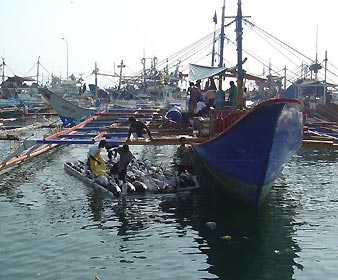
More than 2,000 fishers will be affected by the Pacific tuna fishing ban. (Photo: FB-Archive)
Tuna companies prepare for fishing bans
 PHILIPPINES
Thursday, January 07, 2010, 23:50 (GMT + 9)
The tuna industry faces tough times through 2012 with the closure of parts of the high seas in the Pacific Ocean where national purse seine vessels routinely fish, a fishing federation official said.
“Filipino purse seine operators have agreed to pull out their fleet because of the closure ordered by the Western and Central Pacific Fisheries Commission (WCPFC) for two years starting 1 January,” said Bayani B Fredeluces, executive director of Socsargen Federation of Fishing and Allied Industries, Inc.
“Some 2,394 workers on board more than 200 fishing boats will be affected,” he noted.
The local fishing federation’s initial study forecasts that tuna catches from purse seine fishing will decline by 10-20 per cent, according to Fredeluces. Six local tuna plants process these vessels’ catches mostly for canned export to the European Union (EU) and the US, PINA reports.
However, the closure order excludes hand line fishing, the method used to land mature tuna for export in fresh form, Fredeluces clarified.
The WCPFC approved the closure order in 8-12 December 2008 in the document “Conservation and Management Measure for Bigeye and Yellowfin Tuna in the Western and Central Pacific Ocean.” The purse seine fishing closure spans two pockets of the high seas within the western and eastern Pacific.
The first pocket covers Palau, Micronesia, Papua New Guinea and Indonesia - the areas closest to the Philippines and where local tuna fishers often work, Fredeluces observed. Pocket two covers the Solomon Islands, Fiji, Tuvalu, Nauru, Marshall Islands, Micronesia, Papua New Guinea and parts of Kiribati.
The ban excludes the high seas around the Cook Islands, French Polynesia and parts of Kiribati.
The WCPFC will review the ban late this year.
Additionally, the WCPFC will again enforce a three-month ban on fish aggregating devices (FAD) in the high seas from July-September 2010 and July-September 2011. The ban was first imposed in August-September 2009.
The FAD ban aimed to lower bigeye and yellowfin tuna catches by 30 per cent to help protect the species during the next three years. FAD uses buoys to draw marlin, tuna, mahi-mahi and other species.
Although the Bureau of Fisheries and Aquatic Resources (BFAR) adopted the ban for the Philippines’ exclusive economic zone (EEZ), Fredeluces said local tuna producers are collaborating on an alternative to the ban, which they are set to soon propose to the bureau.
Related article:
- Two-month tuna ban to commence in August
By Natalia Real
[email protected]
www.seafood.media
|





 Print
Print