|

Source: Taiwan's Fisheries Research Institute / FIS
Taiwan fisheries institute maps migration of spawning bluefin tuna
 TAIWAN
Tuesday, December 13, 2022, 07:00 (GMT + 9)
Taiwan's Fisheries Research Institute (FRI) in collaboration with Stanford University have mapped the migration movements of spawning pacific bluefin tunas through the use of satellite tagging, the FRI said Thursday.
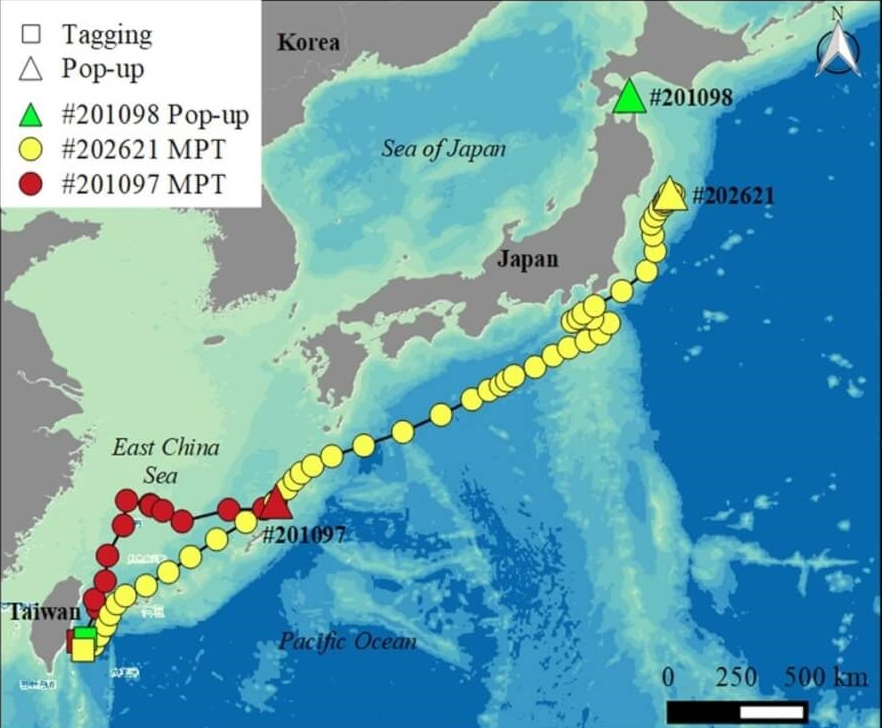
Pacific bluefin tuna migration map. Photo courtesy of the Fisheries Research Institute
The data retrieved from the Pop-up Satellite Archival Tags (PSATs) could be useful to local and international fishery organizations for their research on the sustainability of this tuna species population, the FRI said in a release.
 The PSAT, The PSAT, a data logger that is equipped with means to transmit the collected data via the Argos satellite system, is primarily used to track the movements of large migratory marine animals.
Stanford University biologist Barbara Block (center), Charles Farwell (far left) and graduate student George Shillinger tag a giant bluefin tuna. Image source: Stanford University -->
Citing a 2022 report by the International Scientific Committee (ISC) for Tuna and Tuna-like Species in the North Pacific Ocean, the FRI said although the population of spawning female Pacific bluefin tunas has gradually recovered in recent years, the latest stock assessment finds that it remains heavily overfished.
Image source: Stanford University
In order to understand the spawning migration characteristics and ecological habits of the species, the FRI researchers succeeded in carrying out the experiment on three pacific bluefin tunas weighing 200 kg, 300 kg and 180 kg in waters east of Taiwan in May 2021.
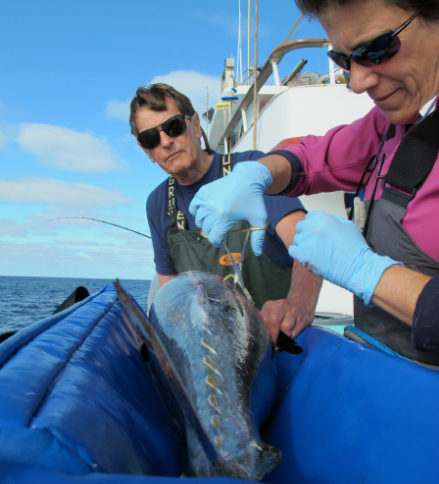
<-- Stanford scientists tag a Pacific bluefin tuna. Image source: Stanford University
A PSAT that releases itself after a specified period of time was attached to each fish, which tracked their movements for a combined 127 days and 13 hours.
Data later collected from the tags showed that the spawning tunas migrated from Taiwan to waters east of Japan, spanning a combined distance of 3,000 kilometers, according to the FRI.
The fish were found to be active in the 300-meter to 500-meter depth zone during the day and they preferred to swim at shallow depths of below 200 meters at night.
It was the world's first that the migration behavior of spawning pacific bluefin tunas has been mapped, the FRI said, adding that the data collected could be used as an important reference for fishery management resource assessment in the future.
.png) According to the institute, the pacific bluefin is a high-economic fish species that is caught seasonally by small and medium-sized Taiwanese longline fishing vessels. The fish caught in the eastern and southeastern waters of Taiwan from April to June every year often already reached the age of sexual maturity (over 6 years old). According to the institute, the pacific bluefin is a high-economic fish species that is caught seasonally by small and medium-sized Taiwanese longline fishing vessels. The fish caught in the eastern and southeastern waters of Taiwan from April to June every year often already reached the age of sexual maturity (over 6 years old).
FRI Director-General Chen June-ru (陳君如) said that Japan had already succeeded in breeding and raising pacific bluefin tunas in captivity.
Chen said Taiwan had once tried breeding yellowfin tunas in captivity but the experiment did not work.
.png) Yeh Hsin-ming (葉信明), who heads the FRI's marine fishery division, Yeh Hsin-ming (葉信明), who heads the FRI's marine fishery division, said the bluefin tuna bred in captivity in Japan were found to have higher fat content and that meat from the fish had made their way to local upscale restaurants and to the United States.
The country is currently also breeding yellowfin tunas in Mexico, Yeh said.
According to the FRI, the pacific bluefin tunas enter maturity after three years, and one of their spawning grounds is from Okinawa in the Philippine Sea which is northwest Pacific Ocean to the waters east of Taiwan, and the season happens between April and July.
The other area is in waters south of Japan, with the spawning season taking place between June and August, it added.
Authors/Source: Yang Shu-min and Ko Lin / Focus Taiwan
www.seafood.media
|





.png)
 Print
Print