|
The authors highlight that the global salmon farming industry must re-evaluate feeding and breeding regimes
Rapid Growth in Farmed Atlantic Salmon Increases Coronary Arteriosclerosis Risk and Compromises Cardiac Function
 FAROE ISLANDS
Monday, October 12, 2026, 00:10 (GMT + 9)
Research from the Faroese institute Firum warns that accelerating commercial fish growth exacerbates vascular lesions and restricts tolerance to operational stress
Photo: Tróndur Dalsgaard
A scientific study conducted by the aquaculture research institute Firum (formerly Fiskaaling), based in the Faroe Islands, has determined that elevated growth rates in commercially farmed Atlantic salmon (Salmo salar) are directly correlated with an increased prevalence and severity of coronary arteriosclerosis. The investigation concludes that pushing body growth acceleration compromises cardiovascular fitness and restricts cardiac pumping capacity during operational or thermal stress events.

The research, led by doctoral researcher Heidi S. Mortensen alongside international scientific collaborators and published in the peer-reviewed journal Aquaculture, examined the coronary arteries of farmed Atlantic salmon across 4 commercial sea cage sites in the Faroe Islands. Histological evaluations demonstrated that faster individual growth rates are linked to greater intimal proliferation and arteriosclerotic thickening within the coronary vessels responsible for supplying vital oxygen and nutrients to the myocardium.
The progression of vascular narrowing was assessed using a standardized histological scale spanning 6 severity levels, ranging from Score 0 (completely unaffected vessel lumen free of lesions) up to Score 5 (advanced arteriosclerosis featuring severe luminal occlusion). According to the study's findings, luminal stenosis impairs blood perfusion and restricts the circulatory system's capacity to deliver required oxygen volumes during routine handling, sea lice treatments, or environmental temperature fluctuations.
 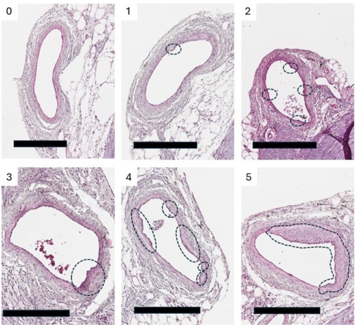
Photo: Heidi S. Mortensen, Firum
The research forms part of a doctoral project jointly funded by Firum, the Research Council of the Faroe Islands (Granskingarráðið), and Innovation Fund Denmark (Innovationsfonden). The authors highlight that the global salmon farming industry must re-evaluate feeding and breeding regimes focused solely on maximizing rapid growth, establishing an operational balance that safeguards cardiac morphology and mitigates cumulative mortality during the marine grow-out phase.
More information
If you would like to know more about the Heart Health at Aldum Laksi (Hjartaheilsa hjá aldum laksi) project , you can contact Heidi S. Mortensen , PhD reader at Firum, at [email protected] or at tel.: + 928 774765.
🇯🇵 日本語 (Japanese Version) | AIによる自動翻訳
タイセイヨウサケの急激な成長が冠動脈硬化症のリスクを高め、心機能に悪影響を及ぼす
フェロー諸島の水産研究機関Firumの最新研究、過度な成長促進が血管病変を悪化させ、ハンドリング等のストレス耐性を著しく低下させると警告
フェロー諸島の水産養殖研究所Firum(旧Fiskaaling)が主導した新たな科学研究により、商業養殖環境におけるタイセイヨウサケ(Salmo salar)の急速な成長率が、冠動脈の動脈硬化症の進行と直接的に相関していることが明らかになりました。本研究は、魚体の過度な成長促進が心血管系の健全性を損ない、作業時や高水温下などの負荷がかかる状況下において心臓の循環応答能力を著しく制限すると結論付けています。
本研究は、Firumの博士課程研究員であるHeidi S. Mortensen氏が国内外の共同研究チームとともに執筆し、国際学術誌『Aquaculture』に掲載されました。研究チームはフェロー諸島の4カ所の商業養殖場においてタイセイヨウサケの冠動脈を組織学的に検査。その結果、成長速度が速い個体ほど、心筋に酸素と栄養素を供給する主要な冠動脈内膜の肥厚および動脈硬化病変の形成が進行していることが実証されました。
冠動脈の狭窄度は、病変が認められない正常な状態であるグレード0から、血管内腔が極度に閉塞した重度の動脈硬化を示すグレード5までの全6段階の評価基準で分類されました。研究結果によると、血管内腔の狭窄は心筋への血流供給を阻害し、給餌管理、海ジラミ駆除処理、水温変動といった負荷時に必要な酸素供給能力を著しく低下させます。
本研究は、Firum、フェロー諸島研究評議会(Granskingarráðið)、およびデンマーク・イノベーション基金(Innovationsfonden)の共同助成による博士課程プロジェクトの一環として実施されました。著者らは、急速な成長のみを追求する従来の給餌戦略や育種方針を見直し、心臓の健全性を維持して海面養殖期間中の死亡率を抑制する持続可能な生産バランスの確立が急務であると警鐘を鳴らしています。
🇨🇳 中文 (Simplified Chinese Version) | 由人工智能自动翻译
养殖大西洋鲑快速生长加剧冠状动脉硬化风险并损害心脏生理功能
法罗群岛Firum研究所最新研究警示:过快生长加重鱼体血管病变,限制操作与环境应激耐受力
由位于法罗群岛的专业水产科研机构Firum(原Fiskaaling)开展的一项最新科学研究表明,商业化养殖大西洋鲑(Salmo salar)的高速生长与其冠状动脉粥样硬化的发病率及病变程度呈显著正相关。研究结论指出,盲目加速鱼体规格生长会损害鱼类心血管系统健康,并在养殖操作或水温波动等应激状态下严重限制心脏的泵血代偿能力。
该项研究由Firum研究所博士研究员Heidi S. Mortensen联合多位国际科研学者共同完成,成果已发表于国际权威学术期刊《Aquaculture》。科研团队对分布在法罗群岛海域4处商业化海水养殖场的大西洋鲑冠状动脉组织进行了病理学切片分析。组织学结果证实,个体生长速率越快,负责向心肌层输送氧气与关键养分的冠状动脉内膜增生与硬化钙化病变就越严重。
研究采用了包含6个病变等级的标准病理学评分系统来界定血管狭窄程度,范围从完全无血管病变及管腔通畅的0级,直至出现严重管腔狭窄及闭塞的晚期动脉硬化5级。研究指出,冠状动脉管腔的进行性狭窄显著减少了心肌血流灌注,直接削弱了大西洋鲑在应对日常分级操作、海虱药浴处理以及环境升温等高耗氧应激环节中的循环调节能力。
该课题属于由Firum研究所、法罗群岛研究理事会(Granskingarráðið)以及丹麦创新基金(Innovationsfonden)联合资助的博士科研项目。研究人员特别强调,全球鲑鳟鱼类养殖产业有必要审视仅以最大化生长速度为导向的投喂模型与选育机制,亟需在快速增重与维护鱼体心脏机能健康之间建立科学平衡,以有效降低海水养成阶段的累积死亡率。
[email protected]
www.seafood.media
|




 Print